Last updated: November 19, 2026
How to Test Fabric Stretch and Recovery at Home tells you if a knit will give where it should and spring back after you pull it. The quick answer: measure a known length, stretch it, then check how far it returns after 1 minute. The steps below settle stretch percentage, recovery, and the difference between lengthwise and crosswise stretch.
What fabric stretch and recovery tell you before you cut
How to Test Fabric Stretch and Recovery at Home starts with a simple check: you have a piece of knit fabric on the table, and you need to know if it will work for a sleeve cuff, a waistband, or a close-fitting top. The test is simple: use a fabric ruler, a marked starting line, and a steady pull to see how much the fabric length changes and how well it snaps back.
Stretch tells you how far the cloth will give. Recovery tells you how much of that give it keeps after the pull. A fabric can stretch a lot and still recover poorly. That’s the problem.
Key Takeaways
- Stretch and recovery are two different checks.
- Test both crosswise stretch and lengthwise stretch.
- Measure from a fixed starting point, not by eye.
- Watch what happens after 1 minute of stretch.
- A knit can look stretchy and still bag out.
- Woven fabric usually shows far less give than knit fabric.
What tools do you need for a home stretch test?
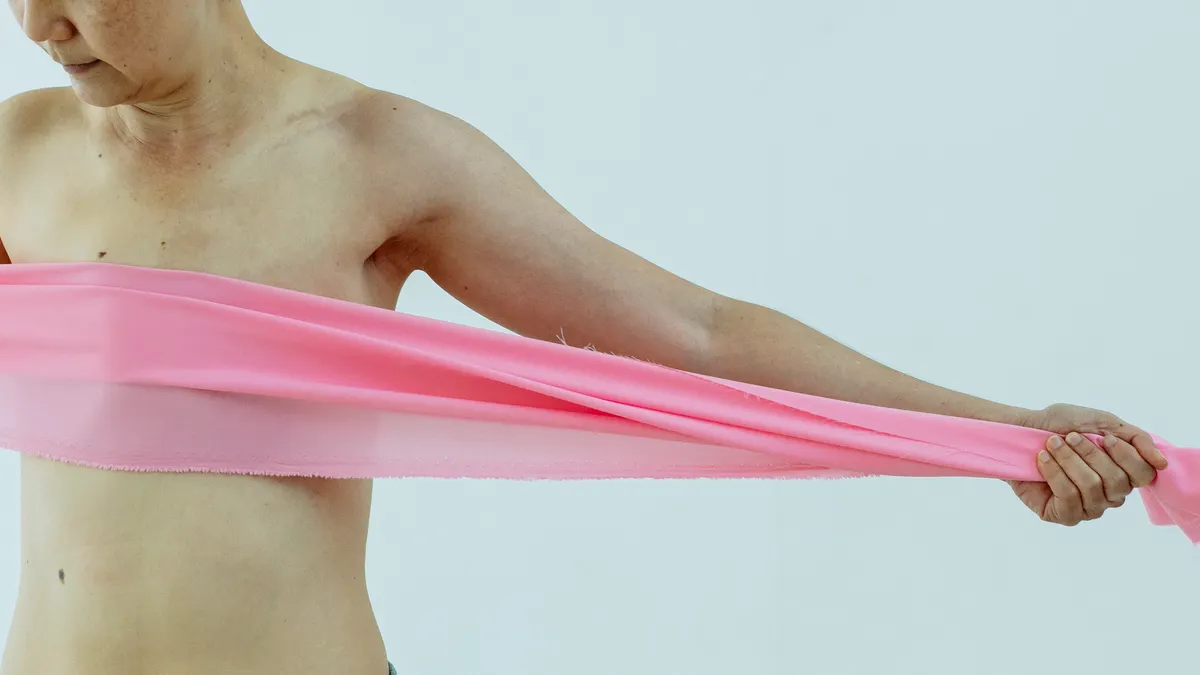
You need a fabric ruler, two pins or clips, and a flat surface; a chalk pencil and a scrap of cardboard help, too. A simple tape measure works if it has clear inch or centimeter marks, but a ruler gives cleaner start and stop points.
Here’s the catch: sloppy setup gives sloppy results. If the cloth shifts while you pull, the number is junk, even if it looks neat on paper.
Gather these items before you start:
- Fabric ruler or clear ruler
- Sewing tape measure
- Pins, clips, or painter’s tape
- Chalk, washable pen, or a thread marker
- A flat table or cutting mat
- A scrap of stiff cardboard for marking edges
Use a test strip at least 6 inches long and wide enough to grip without distorting the edge. If the fabric frays hard, fold the ends over 1 inch and clip them so your hands stay off the measurement area.
How do I test fabric stretch and recovery at home?
You test it by marking a fixed length, stretching the fabric in one direction, and checking both the extra length and the return after release. The clearest home method uses a 4-inch or 10-centimeter marked section because it is easy to measure and repeat.
Do the same test in both directions. Knits often stretch more across the width than along the length, while woven fabric may give only a small amount unless it contains elastic.
- Mark a 4-inch section on the fabric with chalk or tape.
- Measure the starting length with a fabric ruler and write it down.
- Stretch the fabric gently in one direction until you feel firm resistance.
- Measure the new length while held under that same pull.
- Release the fabric and let it rest for 1 minute.
- Measure the relaxed length again and note how close it returns to the start.
- Repeat the test across the width and then along the length.
If you want a stretch percentage, use the starting length and the stretched length. A 4-inch section that stretches to 6 inches has stretched by 50% because it gained 2 inches over the original 4.
How do you read stretch percentage without getting fooled?
You read stretch percentage by comparing the gain in length to the original length, not by guessing from the hand feel. A fabric that feels “very stretchy” can still have a low percentage if the starting length was short.
Use this simple rule:
- Original length = 4 inches
- Stretched length = 5 inches
- Gain = 1 inch
- Stretch percentage = 25%
That same method works with 10 centimeters or any other starting length. The math stays the same.
A few things distort the reading:
- Pulling harder on one pass than the next
- Measuring from a curved edge instead of a straight line
- Letting the strip twist while stretched
- Grabbing the fabric too close to the marked section
The truth is, the number matters less than consistency. If you test three spots and get similar results, the fabric behaves evenly. If one spot stretches much more than another, the cloth may be unevenly knitted, cut off grain, or weakened in a worn area.
What counts as good recovery?
Good recovery means the fabric returns close to its starting length after you let it rest. If the strip stays visibly longer after 1 minute, that is a warning sign for hems, cuffs, knees, elbows, and waistbands.
Recovery is about shape retention, not just stretch. A fabric can pass the pull test and still leave a saggy edge after wear. That’s why the return check matters as much as the stretch number.
Watch for these results:
- Strong recovery: the strip looks nearly the same as before
- Fair recovery: a little length stays, but the shape is mostly back
- Poor recovery: the strip stays stretched out or waves at the edges
A knit with elastic content usually rebounds better than a similar knit without it, but that is not a guarantee. Rib knit and interlock often behave differently from loose jersey, even if they look similar on the bolt. If the fabric relaxes slowly, give it the full 1 minute before you judge it.
How do knit fabric and woven fabric behave differently?
Knit fabric usually stretches more and recovers more visibly than woven fabric, while woven fabric usually stays steadier unless it contains a mechanical stretch or elastic fiber. That difference is why the same test tells you different things on each cloth.
Picture two strips side by side. One is a jersey knit with obvious give across the width. The other is a plain woven cotton that barely moves. Both get the same 4-inch test, but only one will show much extra length.
Use this comparison as a guide:
- Knit fabric: often stretches more across the width
- Woven fabric: often resists stretch, unless it has added elastic
- Elastic fabric blends: may recover better than plain cotton or linen
On the flip side, don’t assume every knit behaves the same. A dense ponte, a loose jersey, and a rib knit can all show different stretch percentages and different return. That is why a home test beats a guess from the bolt end.
If a woven fabric stretches a little, that does not make it a knit. It may just have a small amount of bias give or a touch of elastane. The test tells you how the cloth acts; it does not rename the cloth.
Common mistakes that give bad results
Bad results usually come from uneven pulling, bad measuring, or testing only one direction. Each mistake hides the real behavior of the fabric and can lead to a garment that fits fine in the flat and fails on the body.
Here’s what goes wrong and what it costs you:
- Pulling too hard: inflates the stretch percentage and can damage the test strip
- Testing near a cut edge: the edge distorts and gives a false number
- Skipping the rest period: makes poor recovery look better than it is
- Using a wrinkled strip: hides true stretch and return
- Testing only crosswise stretch: misses lengthwise behavior that matters in some garments
Use the middle of the fabric when you can. Keep the pull smooth. Measure the same way every time. If a fabric is slippery, clip it to a scrap of cardboard before you stretch it so the edge stays flat.
A simple notebook helps here. Write the direction, starting length, stretched length, and relaxed length for each sample. Two or three notes take less than 5 minutes and save a lot of second-guessing later.
How to use the result when you choose a sewing fabric
Use the result to match the fabric’s behavior to the kind of stretch your project needs. A cuff, collar, or fitted knit top needs better recovery than a loose tee, because the edge has to come back after wear.
A fabric with strong stretch but weak recovery can work for drapey shapes, but it often fails at tight openings. A fabric with low stretch may work for a boxy top, but it can fight you on a body-hugging piece. That trade-off matters more than a label on the bolt.
Use these notes as a final check:
- Stretch percentage tells you how much give you have
- Recovery tells you how well it bounces back
- Crosswise stretch usually matters most for fit
- Lengthwise stretch matters for length stability and shape
The best part? You do not need a lab setup. A ruler, a marker, and one strip of cloth tell you far more than a quick tug with your hands. For broader fabric choices, the hub on fabric and pattern selection can help you connect this test to the right project.
How do I test stretch fabric at home?
Mark a 4-inch or 10-centimeter section, stretch it in one direction, and measure how far it grows and how much it returns after 1 minute. Repeat the same test across the width and along the length so you can compare both directions. Use a ruler and a flat surface for the cleanest result.
What is fabric recovery?
Fabric recovery is the fabric’s ability to return close to its original size after being stretched. Good recovery means the cloth springs back with little leftover length. Poor recovery means the strip stays stretched or looks wavy after release.
How much stretch should a knit have?
The right amount of stretch depends on the garment, but a knit should stretch enough to go on and move without fighting the body. More important than a single number is whether the fabric also recovers well after being pulled. Test both directions before you cut, because two knits can feel similar and behave very differently.
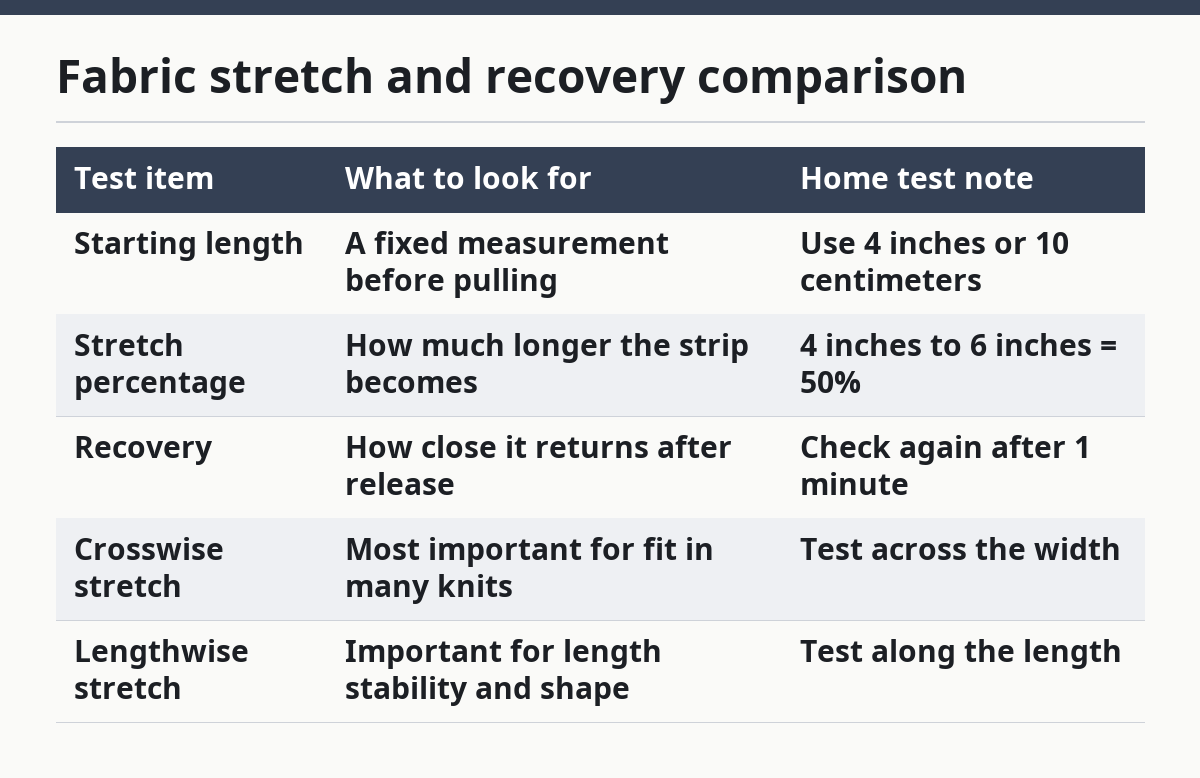
Fabric stretch and recovery comparison
| Test item | What to look for | Home test note |
|---|---|---|
| Starting length | A fixed measurement before pulling | Use 4 inches or 10 centimeters |
| Stretch percentage | How much longer the strip becomes | 4 inches to 6 inches = 50% |
| Recovery | How close it returns after release | Check again after 1 minute |
| Crosswise stretch | Most important for fit in many knits | Test across the width |
| Lengthwise stretch | Important for length stability and shape | Test along the length |
FAQ
What is the easiest way to test fabric stretch at home?
The easiest way is to mark a 4-inch or 10-centimeter section, stretch it in one direction, then measure the stretched length and the relaxed length after 1 minute. That gives you both stretch and recovery with a ruler and a flat surface.
Should I test both crosswise and lengthwise stretch?
Yes. Crosswise stretch often affects fit, while lengthwise stretch can affect shape stability and how the garment hangs. Testing both directions gives a clearer picture of how the fabric will behave.
What does poor fabric recovery look like?
Poor recovery looks like a strip that stays longer than its starting length, or one that turns wavy at the edges after release. If it does not come close to its original size after 1 minute, treat that as a warning sign.
Why does a knit fabric need a recovery test?
A knit fabric needs a recovery test because stretch alone does not tell you whether it will hold its shape in wear. A fabric can feel stretchy in your hands and still bag out at cuffs, waistbands, or knees after use.
Can woven fabric stretch too?
Yes, woven fabric can stretch a little, especially on the bias or if it contains elastic fiber. The test shows how much give it has, but it does not change what type of fabric it is.
Drafted with AI; not yet reviewed by a person.