Last updated: November 19, 2026
Key Takeaways
- A beginner project is one you can finish without fighting the pattern, the fabric, or the closures.
- A sewing pattern gets harder when it asks for several decisions at once.
- Stable woven fabric usually finishes more easily than stretchy knit fabric because it stays where you place it.
- A first garment works best when it has few seams, forgiving fit, and a closure you can handle without stress.
A beginner sewing project should match your current control of seams, fabric, and finishing, not your wish list. How to Choose a Sewing Project That Matches Your Skill Level starts with one question: what can you already sew cleanly twice in a row? The steps below show how to judge a sewing pattern without guessing.
How do I judge a beginner sewing project?
A beginner sewing project is the one you can finish without fighting the pattern, the fabric, or the closures. If a sewing pattern asks for one or two new skills, that is usually manageable; if it stacks darts, a zipper, and slippery woven fabric, it is not.
Therefore, if you have only 30 minutes to decide whether a pattern belongs in your stack or back on the shelf, use a checklist. You do not need talent math. You need a way to see where the work is hiding.
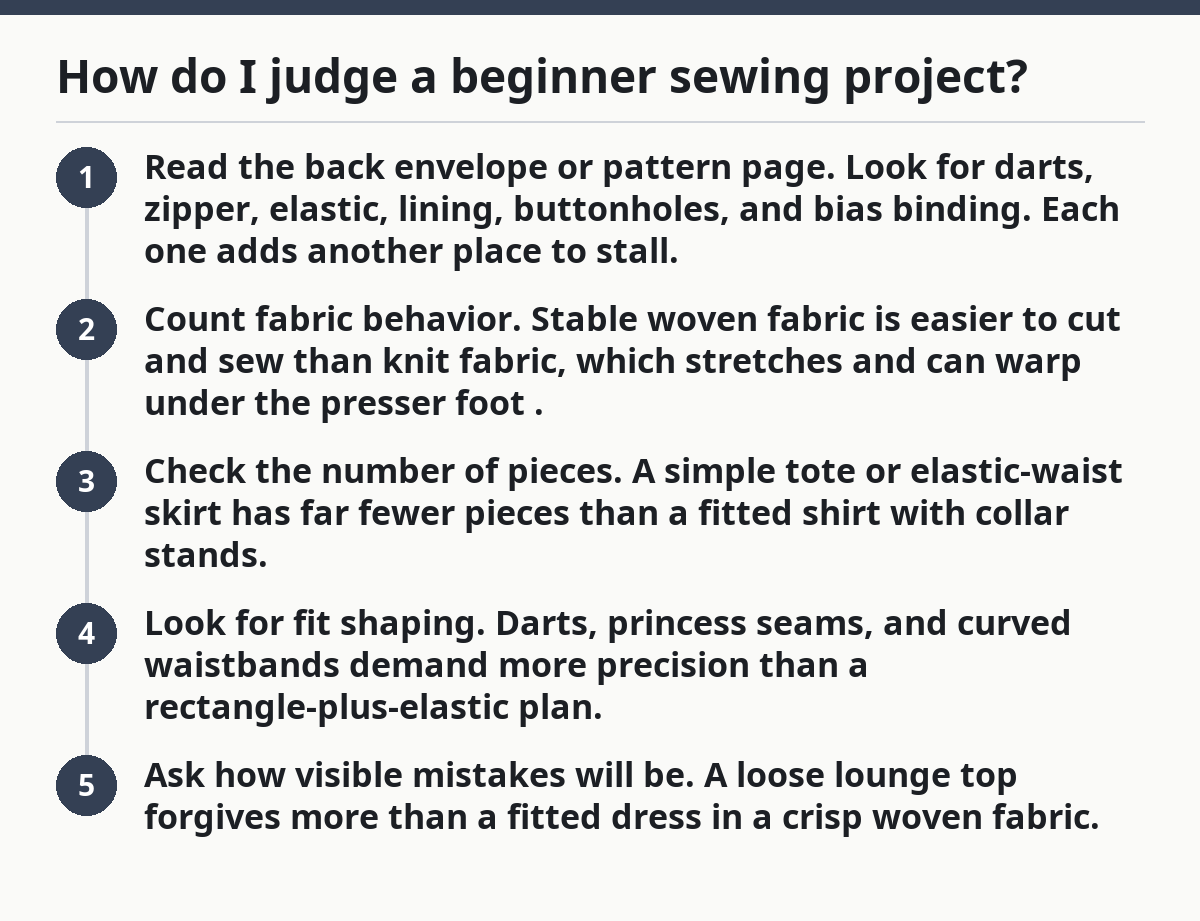
Use this quick filter:
- Read the back envelope or pattern page. Look for darts, zipper, elastic, lining, buttonholes, and bias binding. Each one adds another place to stall.
- Count fabric behavior. Stable woven fabric is easier to cut and sew than knit fabric, which stretches and can warp under the presser foot.
- Check the number of pieces. A simple tote or elastic-waist skirt has far fewer pieces than a fitted shirt with collar stands.
- Look for fit shaping. Darts, princess seams, and curved waistbands demand more precision than a rectangle-plus-elastic plan.
- Ask how visible mistakes will be. A loose lounge top forgives more than a fitted dress in a crisp woven fabric.
Because of that, a pattern can be “beginner friendly” and still be a bad first project if it uses a tricky closure or a fabric that slips all over the place. That is where most readers get burned. The label is not the whole story.
What construction details make a sewing pattern harder?
A sewing pattern gets harder when it asks for more decisions at the same time. A plain top in woven fabric is usually easier than the same top with a zipper, darts, a lining, and narrow hems, because each detail creates a separate chance to miss a seam line or misread an instruction.
For example, if you are comparing two patterns that look similar on the envelope, but one has elastic at the waist and the other has a side zipper plus darts, the second one is not just “a little more advanced.” It asks for fit control, closure control, and pressing discipline in the same project.
Watch for these difficulty flags:
- Darts: These shape fabric to the body. They are not hard by themselves, but they demand accurate marking and pressing. A pattern with four darts is harder than one with none.
- Zippers: A zipper adds alignment, topstitching, and patience. Invisible zippers are less forgiving than exposed ones.
- Elastic: Elastic is simpler than a zipper, but the fit still depends on casing width, stretch, and even gathering. A casing that twists can ruin the finish fast.
- Lining: A lining doubles the layers and can change how seams close. It often means more steps and more bulk at corners.
- Curves and corners: Armholes, necklines, and inset pockets are not beginner blockers, but they require smoother stitching than straight seams.
- Tailoring details: Collars, cuffs, welt pockets, and fitted jackets belong in a later round if you are still learning to keep seam allowance steady.
You do not have to avoid every hard detail forever. You just need to avoid more than one new hard detail in a single project. That is the trap.
Which fabric choice makes a project easier to finish?
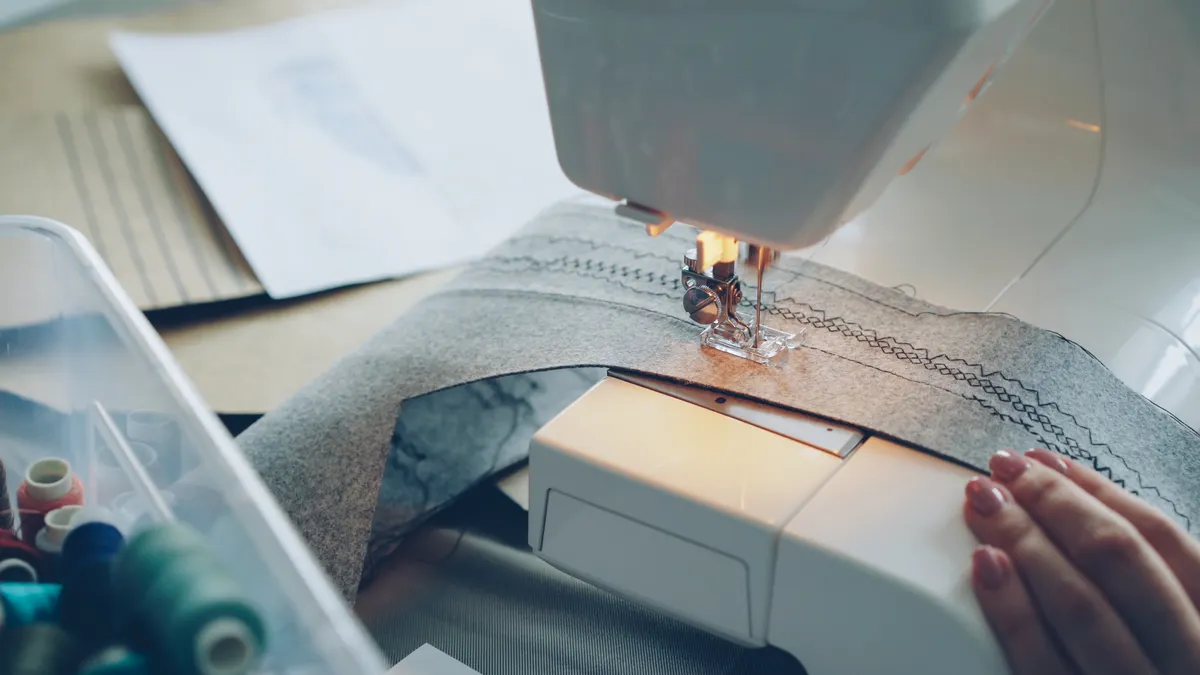
A stable woven fabric usually makes a sewing project easier to finish than a stretchy knit fabric, because it stays where you place it. If you are still learning how fabric feeds through a machine, a woven cotton or linen-like fabric is a calmer first choice than a knit that curls and stretches.
For instance, if your pattern is simple but the fabric slides like silk and your seams wander by 1/4 inch before you notice, a “simple” project can turn into a seam-ripper job. Fabric choice can raise or lower the difficulty more than the pattern art on the envelope.
Use this rule of thumb:
- Choose woven fabric when the project depends on crisp seams, side seams, and clear shaping.
- Choose knit fabric only when the pattern is built for stretch and the instructions mention knit fabric clearly.
- Avoid shiny, slinky, or very open fabrics for your first few projects. They shift, fray, or stretch out of shape while you sew.
- Match fabric to structure. A blouse with darts in a woven fabric is easier to understand than the same blouse in a stretch knit you are trying to force into shape.
- Check the drape the pattern expects. A pattern that wants soft folds can look wrong in a stiff fabric, even if the seams are perfect.
On the flip side, fabric can be too “easy.” A thick or stiff woven fabric may hide mistakes, but it can also make topstitching bulky and seam corners ugly. Easier to cut does not always mean easier to finish. A plain cotton woven is a safer learning fabric than a tricky knit for most first garments.
How should I decide on my first garment?
Your first garment should be something with a small number of seams, a forgiving fit, and a closure you can handle without stress. A beginner sewing project is usually better when it is loose, rectangular, or elasticized, not body-hugging and full of fit changes.
Since the first garment is where many people learn to read a sewing pattern, a dress with bust darts, a back zipper, and a lined bodice is a lot for a first attempt. A drawstring skirt, easy pajama pants, or a boxy top is a steadier start because the shape leaves more room for small errors.
A good first garment usually has:
- Few pattern pieces — fewer than many fitted garments.
- Straight seams — less curve work, less stretching.
- Simple finishing — a hem, facing, or casing instead of heavy tailoring.
- Loose fit — less pressure to nail perfect shaping.
- One main technique — maybe elastic, not elastic plus zipper plus darts.
The honest trade-off is this: a loose first garment may teach less about fitting a body than a fitted one, but it will teach more about reading a sewing pattern, sewing straight, and finishing a project cleanly. That is the better first win. If your first project leaves you with a wearable result, you are much more likely to start the second one.
How do I match a sewing project to my current skills?
You match a sewing project to your current skills by comparing the hardest step in the project with the hardest thing you already do well. If your seams are straight but zippers still fail, do not pick a project that depends on a clean zipper finish.
Specifically, if you can sew a 1/2-inch seam allowance without drifting but still need help installing a zipper, a project with elastic waist or pull-on construction is a better fit than a fitted dress with a center-back zipper. Skill matching is not about labels. It is about the bottleneck.
Run this check before you cut fabric:
- Can I sew straight seams at a steady pace?
- Can I press seams flat without warping the piece?
- Can I read a sewing pattern and follow one new instruction at a time?
- Can I handle the closure used here: elastic, zipper, or buttons?
- Can I manage the fabric type without stretching or fraying it badly?
If one answer is no, the project is probably one step too far. That does not mean “never.” It means “not for this weekend.” A beginner sewing project should stretch your skills a little, not force you to learn six new things before lunch.
Link this thinking to the broader project plan on the hub page for how to plan a sewing project if you want the next step after this choice.
Common mistakes that make a project too hard
The most common mistake is picking a project for how it looks, not for how it is built. A beautiful pattern can still be a bad match if it uses a zipper, darts, a lining, and knit fabric all at once.
For example, you may buy the pattern because the photo looked calm and simple, then the instruction sheet asks for staystitching, understitching, a waistband, and an invisible zipper. That is not a beginner trap by accident. It is a construction pile-up.
Here are the errors that cost the most time:
- Choosing by style alone. The cost is frustration and abandoned fabric. The fix is to read the construction list before you buy.
- Ignoring the fabric match. The cost is seams that twist, sag, or stretch. The fix is to choose the fabric type the pattern expects.
- Overrating one easy detail. An elastic waist does not cancel out a hard bodice or tricky neckline. The fix is to judge the whole garment, not one feature.
- Starting with a fitted garment. The cost is fit trouble before you have basic control. The fix is to start with looser silhouettes.
- Adding “one more challenge.” The cost is a project that never reaches the hem. The fix is to cap the project at one new skill.
A good test is simple: if the pattern asks for three or more techniques you have never done cleanly, save it for later. That is not quitting. That is choosing the right fight.
What should I look for in a sewing pattern before I buy it?
You should look for the construction list, the fabric recommendation, and the closure type before you buy a sewing pattern. Those three items tell you more about difficulty than the cover photo ever will.
However, two patterns can both say “easy,” while one is a boxy woven top and the other is a fitted dress with darts and a back zipper. The label does not settle the question. The details do.
Check these parts of the pattern page:
- Fabric recommendation — woven fabric or knit fabric should be named clearly.
- Closure — elastic is usually simpler than a zipper.
- Shaping — darts, princess seams, and fitted waistbands raise the difficulty.
- Finish type — facings, linings, and bias binding add steps.
- Number of views — extra views can hide extra construction, so read the line drawings too.
If the listing gives a clear materials chart, use it. If it does not, that is a warning sign. A pattern that is vague about fabric or finishing often makes the sewing harder than it needs to be.
Since the parts are what matter, a beginner sewing project should be the one whose pieces you can explain out loud before you cut anything. For more on fit and fabric choice, see how to read a sewing pattern and beginner sewing tools, then compare the project with how to choose fabric for sewing before you buy. The safest beginner sewing project is the one you can describe clearly before cutting.
Frequently asked questions
What sewing project should I make first?
A simple first project is usually a loose garment or a small home item with straight seams, such as an elastic-waist skirt or a boxy top. The best first choice has one main technique, not a stack of them. If a sewing pattern adds darts and a zipper on top of fitted shaping, save it for later.
How do I know if a pattern is too hard for me?
A pattern is too hard if it asks for several skills you have not done cleanly yet, especially if those skills all affect fit or closure. If you cannot clearly point to the hardest step and say, “I’ve done this before,” the project is probably above your current level. That is a useful sign, not a failure.
What makes a sewing project beginner friendly?
A beginner friendly project has few pieces, simple seams, forgiving fabric, and a closure you can manage without stress. Woven fabric, elastic, and loose shapes usually make the job easier. A project stops being beginner friendly when it combines darts, a zipper, and tricky fabric in one garment.
Drafted with AI; not yet reviewed by a person.