Last updated: November 19, 2026
Quick Answer
If you want to know How to Tell if Fabric Has a Nap or Directional Print, the fast answer is to check the fabric in three ways: light, touch, and print orientation. In about 2 minutes, you can usually tell whether you need every piece facing the same direction before you cut. If the surface changes under light or the print reads only one way, treat it as directional and, if needed, consult the pattern instructions or a sewing professional.
If your fabric looks right one way and wrong the other, it has nap or a one-way print, and you need to keep every piece facing the same direction. The steps below show how to spot it before you cut.
Key Takeaways
- Nap is a surface direction, not just a print.
- Velvet, corduroy, fleece, and satin often show it clearly.
- A one-way print can act like nap even on smooth cloth.
- Cutting pieces both directions can make one sleeve look darker than the other.
- A quick light test and a simple fold test usually settle it.
How do I tell if fabric has a nap?
Fabric has a nap if the surface looks lighter, darker, smoother, or rougher when you brush it in opposite directions. That change matters because the cloth is not visually identical from every angle.
Picture this: you’re holding fabric under a shop light and it seems to change color when you tip it. That shift is the clue. A true nap usually shows up on velvet, corduroy, fleece, and some satin, while a flat weave may look the same from every direction.
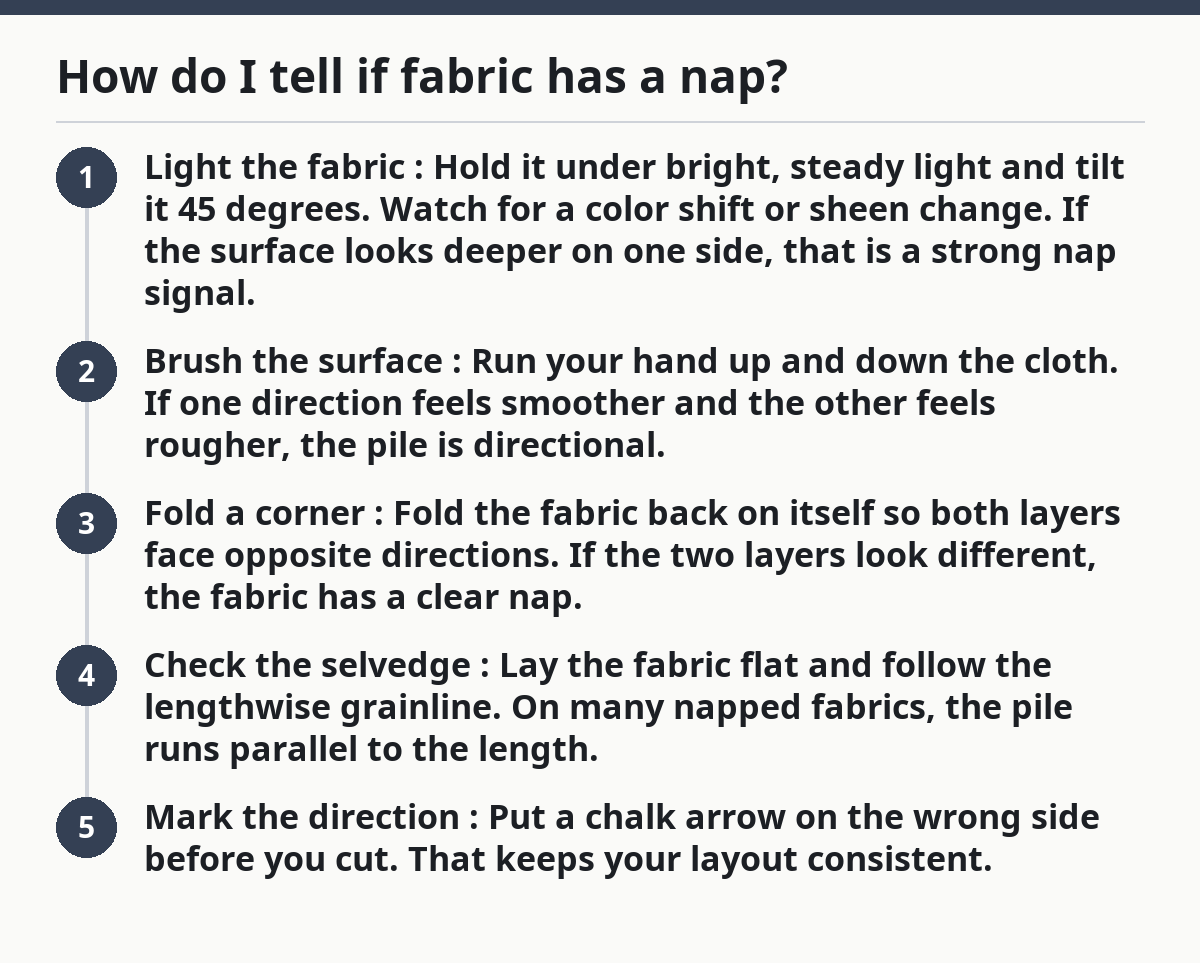
- Light the fabric: Hold it under bright, steady light and tilt it 45 degrees. Watch for a color shift or sheen change. If the surface looks deeper on one side, that is a strong nap signal.
- Brush the surface: Run your hand up and down the cloth. If one direction feels smoother and the other feels rougher, the pile is directional.
- Fold a corner: Fold the fabric back on itself so both layers face opposite directions. If the two layers look different, the fabric has a clear nap.
- Check the selvedge: Lay the fabric flat and follow the lengthwise grainline. On many napped fabrics, the pile runs parallel to the length.
- Mark the direction: Put a chalk arrow on the wrong side before you cut. That keeps your layout consistent.
The truth is, some fabrics hide their direction until you move them. A brushed cotton can look flat at first, then show a clear light-dark change when turned. That is why a quick hand test beats guessing.
What is fabric nap, exactly?
Fabric nap is the directional surface on cloth that changes appearance or feel depending on which way the fibers lie. It is not the same thing as the grainline, though the two often get mentioned together.
Here’s the catch: grainline tells you how the threads run through the fabric, while nap tells you how the surface behaves. You can have a stable grainline on a fabric that still has a strong nap. That is common on velvet and corduroy, where the woven structure and the pile are two different things.
- Nap is surface direction. It comes from raised fibers, loops, or pile.
- Grainline is weave direction. It comes from warp and weft threads.
- A fabric can have both. That is why sewing directions often mention “with nap” cutting.
- A print can create the same problem. A pattern with clear arrows or animals facing one way should usually be treated as directional too; if you are unsure, check the pattern instructions or ask a sewing professional.
A smooth sateen may show a soft sheen that shifts with light, even if you do not feel a pile. That still counts when you plan a layout. If the surface changes in one direction and not the other, assume the fabric needs consistent orientation.
How do I tell which way a print goes?
A print goes one way if the design reads clearly in only one direction or looks wrong when turned upside down. That includes florals with stems, stripes with a top and bottom, novelty prints, and border prints.
Picture this: you spread out fabric with birds, leaves, or letters on it, and the picture looks fine one way but upside down the other. That is a directional print, even if the cloth itself has no nap. The print is doing the same job as a pile: it sets the direction.
- Find a repeated motif: Look at one full repeat, not just a single flower or icon. Repeats often reveal whether the print has a top.
- Turn the fabric 180 degrees: Flip it end to end. If the design reads backward or upside down, the print is directional.
- Check borders and edges: Border prints usually have a clear top edge and bottom edge. The layout must respect that.
- Compare pattern pieces: Place two cut pieces side by side. If one must point up and the other down to fit, the print is directional and the layout needs more fabric.
- Read the fold line: If the print has a definite “up,” fold the fabric so both halves face the same way before cutting.
On the flip side, some prints are scrambled or all-over, with no obvious top. Those can often be cut in either direction. Still, if the motif feels even slightly directional, treat it like one-way print and lay everything out the same way; if you are unsure, consult the pattern instructions or a sewing professional.
Which fabrics most often have nap?
The fabrics most likely to have nap are pile and brushed fabrics, especially velvet, corduroy, fleece, suede-like knits, and brushed cotton. These fabrics show a clear directional surface because of how the fibers stand up or are cut.
A quick look at corduroy ribs, a light tilt across velvet, or a brush over fleece usually tells the story fast. Those materials are the classic cases where pattern pieces turn out darker, lighter, or flatter if cut the wrong way.
- Velvet: The pile reflects light strongly, so direction shows fast.
- Corduroy: The wales give you a visible line that must stay consistent.
- Fleece: The fuzzy surface often looks smooth one way and dull the other.
- Satin: The sheen can shift enough to matter, even without a raised pile.
- Brushed cotton: The finish can make one side appear softer and lighter.
The cost of ignoring nap is simple: parts of the garment can look mismatched once sewn. A sleeve, pocket, or collar may appear darker than the body panel. That is why the cutting layout matters as much as the stitch line.
How should I cut fabric with nap or a directional print?
You should cut all pieces in the same direction and use a layout that matches the fabric’s top and bottom. That usually means you need more yardage than you would for a non-directional cloth.
Picture this: you are laying out pattern pieces on velvet or a one-way print, and one piece wants to turn the opposite way to save fabric. Do not do it. A few inches saved on the table can turn into a visible mismatch after sewing.
- Place the pattern on one direction: Keep every piece pointing the same way as the nap or print. The result should read consistently from hem to collar.
- Use the grainline arrow: Align the arrow on each pattern piece with the fabric length, not across it. This keeps the drape and surface facing the same way.
- Cut on a single layer if needed: Folding fabric can tempt you to mirror one piece backward. Single-layer cutting avoids that risk on directional fabric.
- Mark every piece: Transfer a small arrow to each cut panel so you do not mix them during sewing.
- Leave extra room in your layout: Directional cutting often uses more fabric, especially on large pieces like skirt panels or coat fronts.
A common mistake is rotating one piece 180 degrees to “fit better.” That can create a panel that catches the light differently from the rest. It also makes matching seams harder when the print has a clear repeat.
What mistakes cause nap and print problems later?
The biggest mistakes are cutting on the fold without checking direction, ignoring the print repeat, and assuming all smooth-looking fabric is directionless. Those shortcuts can leave you with mismatched color, shiny patches, or a visible seam that looks off from a few feet away.
The truth is, people miss nap because they expect it to feel obvious. It often is not. A satin finish may seem even until the garment hangs under daylight, and a simple floral print may hide a top edge until you inspect the repeat.
- Mistake: cutting from both ends of the fold. Cost: one half can read darker or flatter. Do this instead: keep the whole layout facing one direction.
- Mistake: trusting the first glance. Cost: you may miss directional sheen. Do this instead: tilt the cloth under light before you cut.
- Mistake: ignoring the repeat. Cost: motifs can land upside down or uneven. Do this instead: map one full repeat before placing pattern pieces.
- Mistake: skipping markers. Cost: pieces get mixed after cutting. Do this instead: label the wrong side and the top edge.
A sewing pattern may not always call out “with nap,” but the fabric can still need it. When in doubt, treat the cloth as directional; if you are unsure, consult the pattern instructions or a sewing professional. That choice is slower, but it can prevent an error you notice only after the seams are closed.
What should I check before I cut the first piece?
You should check the light, the hand feel, the print repeat, and the grainline before a blade touches cloth. A 2-minute inspection can save a project from looking off.
Picture this: you are standing at the cutting table with scissors ready and the fabric still in one long length. This is the moment to settle direction, not halfway through the bodice or sleeve. If the fabric is directional, every cut after that depends on the first decision.
Use this quick order:
- Look at the fabric under a lamp or window.
- Brush it with your hand in both directions.
- Flip one end to see whether the print still reads correctly.
- Align the pattern grainline with the fabric length.
- Mark the top side with chalk or a pin.
That last step matters on busy prints as well as napped fabrics. Once pieces are cut, it becomes much harder to tell which end was up. A clear mark saves time during sewing and fitting, especially on large panels like skirt fronts or coat backs.
If you want a broader sewing foundation, the fabric and pattern selection hub has the bigger map. This page is the narrow check: nap, print direction, and how to cut without making a mess of the layout.
What if I still can’t tell?
If you still cannot tell, treat the fabric as directional and cut it all one way. That is the safer call when a cloth sits between obvious nap and no nap.
Some fabrics sit in the gray zone. A low-pile fabric may show a change only under bright side light, and a subtle print may look nearly even until it is sewn into a shape. In that case, the wrong choice shows up in the finished garment, not on the cutting table.
- Choose consistency over fabric-saving. A little extra yardage is cheaper than a visible mismatch.
- Use the same orientation for every piece. This keeps sheen, texture, and print top-to-bottom in line.
- Keep a sample scrap. Hold it against the finished piece later if you need to check direction again.
This rule is simple: if your eye catches a direction, respect it. A fabric does not need a dramatic pile to count as directional. Even a faint surface shift can become obvious once seams, curves, and lighting all start working against you.
What is fabric nap?
Fabric nap is the way a cloth’s surface looks or feels different when turned in opposite directions. It usually comes from pile, brushed fibers, or a finish that catches light one way more than the other. Velvet, corduroy, fleece, and some satin are common examples.
How do I tell which way a print goes?
A print goes one way if the design reads correctly in only one direction. Flip the fabric end to end and look for upside-down motifs, arrows, text, borders, or stems that point toward a clear top. If the print looks wrong when turned, it is directional.
Does nap change cutting layout?
Nap changes cutting layout because every piece has to face the same direction. That usually means you cannot mirror pieces freely, and you may need more fabric than a non-directional layout would use. The payoff is a garment that looks even from panel to panel.
Drafted with AI; not yet reviewed by a person.