Last updated: November 19, 2026
Quick Answer: For many sewing projects, a 40-weight all-purpose polyester thread is the best first purchase. It handles seams, fabrics, and machines across a broad span of jobs. Pick thread by seam use first, then fiber content, then weight.
Thread choice should follow the task, not just the fabric color. In How to Choose the Right Sewing Thread for a Project, the decision usually comes down to three things: fiber content, thread weight, and how the seam will be used. One spool rarely covers everything. That’s normal.
Key takeaways
- Choose thread for the stress the seam will take, not only for what the fabric is made of.
- Polyester thread is often a practical all-purpose pick for many machine-sewn seams because it has strong stretch and wear resistance.
- Cotton thread still makes sense for quilting, natural-fiber fabrics, and projects that will be pressed hard.
- Thicker thread shows more, so topstitching thread belongs where the seam is meant to be seen.
- If the thread is too heavy for the needle or too fine for the job, the seam can look sloppy or wear out early.
What should I look at first when choosing sewing thread?
Start with the seam itself. What must the stitch survive? What can the fabric tolerate? Should the line disappear, or should it show?
A T-shirt hem, a denim topstitch, and a cotton quilt block do not ask for the same thread, even if the machine never changes.
Three details narrow it fast:
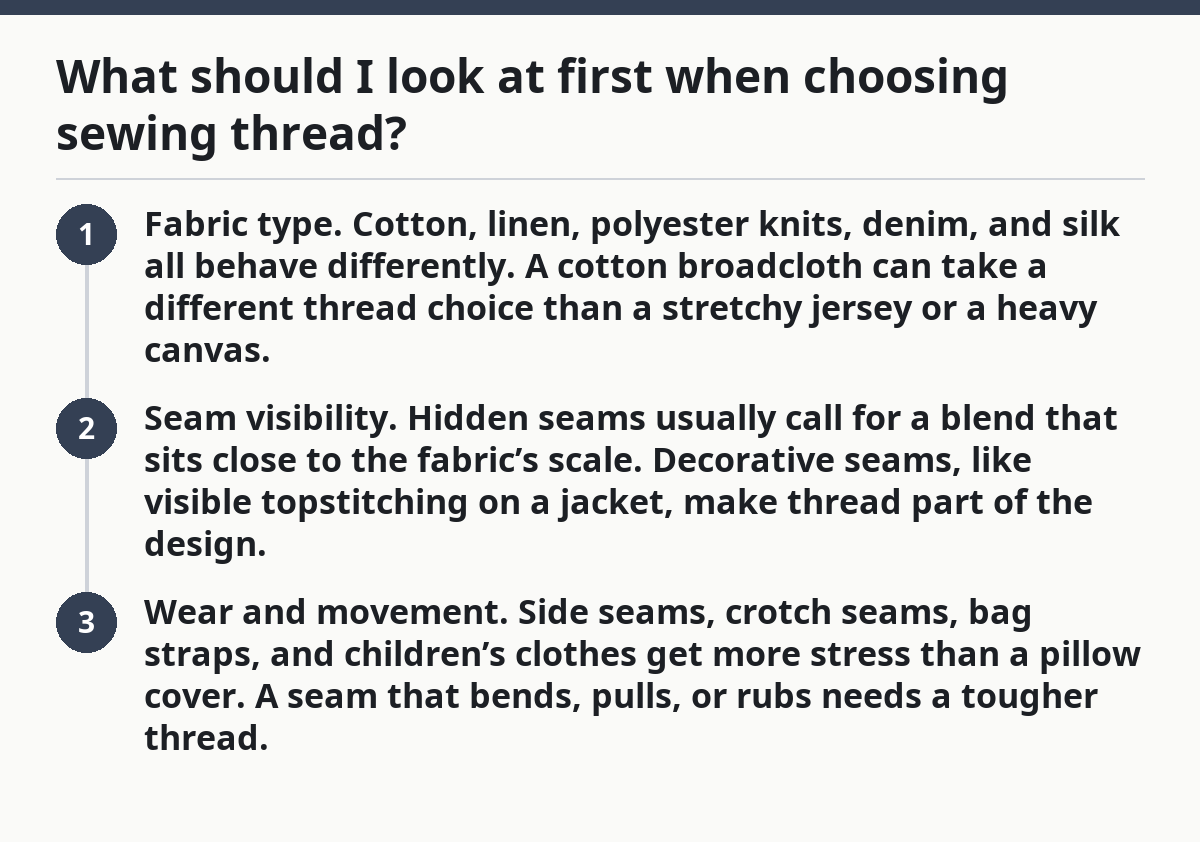
- Fabric type. Cotton, linen, polyester knits, denim, and silk all behave differently. A cotton broadcloth can take a different thread choice than a stretchy jersey or a heavy canvas.
- Seam visibility. Hidden seams usually call for a blend that sits close to the fabric’s scale. Decorative seams, like visible topstitching on a jacket, make thread part of the design.
- Wear and movement. Side seams, crotch seams, bag straps, and children’s clothes get more stress than a pillow cover. A seam that bends, pulls, or rubs needs a tougher thread.
Buying by color alone is a common mistake. A thread can match the fabric tone and still be the wrong thickness or fiber. Another slip: assuming one spool does everything. That leads to seams that look too flat, too bulky, or too weak.
A good starting point is a polyester all-purpose thread. It covers many ordinary seams and is easy to keep on hand. But it is not the answer for every project. Very fine silk, heirloom sewing, and some quilting work call for other choices. For a broader kit, this page fits alongside the hub on [sewing tools and supplies].
How do thread fiber content and project type fit together?
Thread fiber content should follow the fabric and the job, with polyester as the default, cotton for natural-fiber projects, and specialty thread for decorative seams. Simple rule. Real-world trade-offs.
Polyester thread is the broadest-utility choice. It has enough strength and give for many machine-sewn seams, and it handles stress better than thread that has little stretch. That makes it a sensible pick for everyday garments, household sewing, bags, and most repairs. In practice, it is the least fussy option for general use.
Cotton thread suits cotton fabrics, quilting, and projects where the finish should look soft and traditional. It lies well in pressed seams and blends naturally with natural-fiber cloth. The drawback is plain: cotton thread generally has less give than polyester, so it can be less forgiving on seams that move a lot, especially in knits or activewear.
Topstitching thread is thicker and more visible. It belongs on seams meant to be seen, such as denim topstitching, edge stitching on collars, or decorative seaming on jackets and bags. It gives a bold line and a more finished look, but it also asks for the right needle and a project that can handle the extra bulk. Use it in a normal seam, and the stitch can look oversized fast.
Matching fiber content is not always the goal. A polyester thread can work well on cotton fabric if the seam needs durability. A cotton thread can be the better aesthetic match even when the fabric blend includes synthetics. The fabric content is a clue, not a command.
How to choose the right sewing thread for a project
Choose thread by matching seam use, fiber, and weight in that order. This is the core process that cuts down on bad buys and seam problems later; it is not a guarantee, though. For a borderline project, consult a sewing professional or test scraps first, as recommended in general sewing guidance from Sewing.org.
- Identify the seam’s job. Decide whether the seam is structural, decorative, or invisible. A side seam on jeans needs durability; a visible edge stitch on a tote needs presence; a quilt seam needs to stay flat. Get this right first, and the seam’s purpose is clear before you look at the spool.
- Check the fabric content and behavior. Look for whether the fabric is woven or knit, stable or stretchy, light or heavy. Cotton poplin, denim, jersey, canvas, and silk each guide the thread choice differently. When the cloth and the thread fit, they stop fighting each other.
- Pick the fiber content that fits the task. Use polyester for many everyday seams, cotton for quilting and natural-fiber work, and topstitching thread when the seam needs to show. For many general sewing projects, a polyester all-purpose thread is a sensible first buy. That choice feels practical instead of guessed.
- Match the thread weight to the look you want. Finer thread disappears more easily; thicker thread reads as a design feature. A standard all-purpose thread is usually suitable for ordinary seams, while topstitching thread is intentionally heavier and more visible. Done well, the seam looks proportional rather than clunky.
- Choose a color that serves the seam. Match the fabric closely for hidden construction seams, or use a deliberate contrast for topstitching and decorative detail. On medium-tone fabrics, a near-match usually hides better than a perfect-looking color that is the wrong fiber or thickness. In the right spot, thread vanishes; in the wrong one, it becomes the point.
- Check that the thread suits the needle and machine setup you already plan to use. Heavier thread needs more room in the needle eye and in the stitch path, while lighter thread passes more easily. If the thread is visibly oversized for the project, switch before sewing the whole seam. Then the stitch line looks balanced.
A useful rule of thumb: if the seam is holding weight or seeing friction, favor strength and durability; if the seam is mostly visual, favor appearance. Sounds obvious, but many projects miss it. A decorative bag edge with ordinary thread can look underfinished. A delicate blouse sewn with bulky topstitching thread can look heavy and stiff.
One honest limitation belongs here: no single thread choice is ideal for every seam on a garment. A jacket can use one thread in construction seams and another in visible topstitching. That is normal, not sloppy.
When should I use polyester thread instead of cotton?
Use polyester thread for most everyday sewing, especially when the seam has to flex, rub, or last through repeated wear. That includes many garments, bags, children’s clothes, home-sewing repairs, and seams that will be washed often.
Polyester’s practical advantage is durability across a wide range of fabrics. It tends to be the least fussy choice when you do not want the thread to limit the project. A woven cotton shirt, a polyester-cotton blend, and a canvas tote can all usually take polyester thread without drama.
Cotton thread still earns its place in several projects. Quilters often choose cotton because it behaves naturally with cotton fabric and presses cleanly in pieced seams. Historical or traditional garments may also call for cotton for visual consistency. If the project is meant to look soft, matte, and natural, cotton can suit the finish better than polyester.
The trade-off is simple: polyester gives more general durability, while cotton gives a more traditional look and feel. Polyester is the weaker choice for someone chasing a soft, heritage finish or very specific quilting conventions. Cotton is the weaker choice for someone sewing a seam that needs more stretch and wear resistance than cotton thread can comfortably provide.
A practical example helps. If the project is a denim apron with visible seams, polyester thread in the construction seams and topstitching thread on the visible edges makes sense. If the project is a patchwork quilt, cotton thread often keeps the feel and appearance consistent. That is the difference between thread chosen for the fabric and thread chosen for the seam’s real job.
What thread weight should I pick for a seam?
Pick a thread weight that matches the size of the stitch you want to see and the bulk the fabric can hold. Fine thread makes a quieter seam; thicker thread makes a stronger visual statement and can build more bulk in the seam line.
Beginners often miss this part. A thread that looks fine on a spool can behave very differently in a seam. Heavier thread fills the needle holes more and can make topstitching stand out sharply. Lighter thread blends better into a seam but may not give the bold outline you want on denim, bags, or decorative edges.
For example, hidden seams usually work well with standard all-purpose thread. Quilting seams often stay flatter with a smoother, finer thread. Topstitching needs a thread weight that reads from a distance. Delicate fabrics need a finer thread so the seam does not overwhelm the cloth.
Bulk is the drawback of thicker thread. On a seam with multiple layers, it can make the fabric harder to fold, press, or topstitch cleanly. That is why topstitching thread is a design decision, not a default. It is the wrong pick for a narrow hem on lightweight fabric, and it is also the wrong pick when the seam should disappear.
A good test is visual: if you can already see the seam from the distance at which the garment will be worn, the thread may be too heavy for a subtle construction seam. If a decorative seam is supposed to be the feature and you cannot see it, the thread may be too fine.
What are the most common thread mistakes?
The most common mistakes are using thread that is too decorative for a hidden seam, too fine for a stressed seam, or too different from the fabric’s purpose. These mistakes cost time because they usually show up after the seam is sewn, pressed, and trimmed.
First, people choose color before function. A thread can match the fabric perfectly and still be the wrong fiber or thickness. The fix is to decide on seam job first, color second.
Second, some sewists use topstitching thread everywhere because it looks premium. It does not. On many seams, it creates unnecessary bulk and can make the project feel stiff or overbuilt. Save it for visible seams where the line matters.
Third, cotton thread is not always the “natural” choice for cotton fabric. That is not true. A cotton garment can do better with polyester thread if the seam needs more durability or movement.
Fourth, a thread can be too fine on a seam meant to carry stress. The result may look underfed and wear faster than the fabric itself. The seam may still sew, but it will not age well.
A useful habit is to keep three thread types on hand: all-purpose polyester, cotton, and topstitching thread. That small set covers most projects without turning your thread shelf into a storage problem. If a project falls outside those three, it usually means the seam has a special job and should be treated like one.
For broader buying and organizing decisions, the article cluster on sewing supplies belongs here more than the thread choice itself does.
How do I decide when thread should match fabric fiber content?
Thread should match fabric fiber content when the project’s look, feel, or tradition depends on that match, but it does not have to match in every project. That approach prevents a lot of unnecessary rules.
Matching makes the most sense in these situations:
- Quilting and heirloom sewing: cotton thread on cotton fabric keeps the finish consistent.
- Natural-fiber garments: cotton or cotton-wrapped thread may suit the hand and appearance better.
- Visible stitching on traditional pieces: the thread can be part of the fabric story, not just the construction.
Matching matters less when performance comes first. A work apron, utility tote, gym bag, or kids’ clothing often benefits more from polyester thread than from a strict fiber match. In those cases, the thread should serve the seam’s job, not a catalog rule.
The honest limitation is that “match the fiber” is a good instinct, not a law. A project can be structurally sound with a different fiber in the thread than in the cloth. What matters is whether the seam behaves well, sits cleanly, and looks intentional. If the seam is visible and you care about a traditional finish, match more closely. If the seam will be pulled, washed, and worn hard, performance usually wins.
A project-specific decision is better than a universal rule. That is the difference between choosing thread that merely sounds correct and choosing thread that actually suits the seam.
Is polyester thread good for most sewing projects?
Yes, polyester thread is good for most sewing projects because it covers a wide range of seams without being too fragile or too stiff. It works especially well for garments, household sewing, bags, and repairs. It is less ideal when you want a traditional cotton finish or a very specific quilting look. According to Coats & Clark’s consumer guidance, all-purpose polyester is a standard choice for many general sewing tasks.
Should thread match fabric fiber content?
Not always. Thread should match fabric fiber content when the project needs a coordinated look or a traditional finish, such as quilting or heirloom sewing. For many practical projects, function matters more than a perfect fiber match, and polyester can be the better choice even on natural fabrics.
What thread is best for hand sewing?
A smooth, medium-weight thread that suits the fabric is usually best for hand sewing. For many general hand-sewn seams, cotton or polyester all-purpose thread works well; for visible hand work, a thread that is appropriate to the fabric and the stitch size is the better fit.
Drafted with AI; not yet reviewed by a person.