Last updated: November 19, 2026
Quick Answer: Use 4 checks—drape, weight, stretch recovery, and hand—before you cut. This How to Check if Fabric Is Suitable for a Sewing Pattern guide shows how to compare the fabric to the pattern without guessing.
Key Takeaways
- Read the pattern envelope first, then check the fabric bolt end for the exact fabric types it suggests.
- Compare the cloth’s stretch, drape, weight, and surface texture to what the pattern needs.
- A fabric can be “right” in fiber content and still fail if it is too stiff, too slinky, too bulky, or too stretchy.
- Do a quick drape, stretch, and recovery check before you buy or cut.
- When the cloth and pattern disagree, the result usually shows up in fit, shape, or how the garment hangs.
How to check if fabric is suitable for a sewing pattern
How to Check if Fabric Is Suitable for a Sewing Pattern starts with structure, drape, stretch, weight, and hand. The safest check is to compare those 5 traits with what the pattern expects before you cut.
This article shows the fabric suitability check in plain steps so you can decide fast. It also explains what the pattern notes really mean when they mention “stable woven,” “knit with stretch,” or “soft drape.”
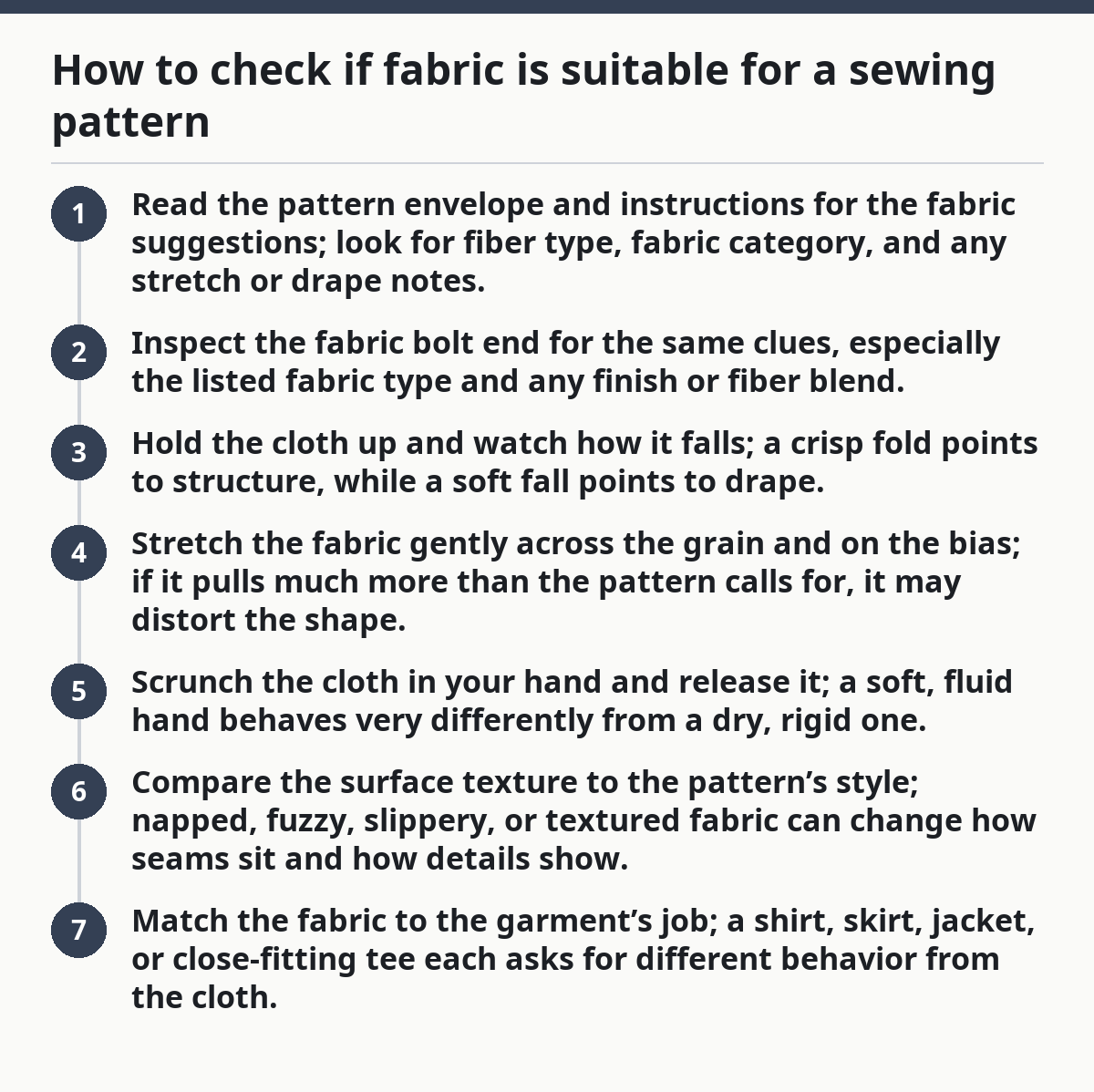
- Read the pattern envelope and instructions for the fabric suggestions; look for fiber type, fabric category, and any stretch or drape notes.
- Inspect the fabric bolt end for the same clues, especially the listed fabric type and any finish or fiber blend.
- Hold the cloth up and watch how it falls; a crisp fold points to structure, while a soft fall points to drape.
- Stretch the fabric gently across the grain and on the bias; if it pulls much more than the pattern calls for, it may distort the shape.
- Scrunch the cloth in your hand and release it; a soft, fluid hand behaves very differently from a dry, rigid one.
- Compare the surface texture to the pattern’s style; napped, fuzzy, slippery, or textured fabric can change how seams sit and how details show.
- Match the fabric to the garment’s job; a shirt, skirt, jacket, or close-fitting tee each asks for different behavior from the cloth.
The truth is, the label alone does not settle it. A rayon can be too limp for a boxy shirt, and a cotton can be too stiff for a gathered dress.
What the pattern is really asking for
The pattern is really asking for fabric behavior, not just fabric content. Picture this: the pattern says “lightweight woven with drape,” and you are staring at three bolts that all look usable from six feet away. The real job is to decode what that line means in cloth behavior, not just in fabric names.
A pattern usually cares about how the fabric behaves, not just what it is made from. “Woven” means the cloth does not stretch much across the body unless it has a special finish or some spandex content. “Knit” means the cloth has built-in give, often needed for tees, leggings, and close-fitting tops.
Look for the pattern’s clues in three places:
- The suggested fabric list on the envelope
- The finished garment photos and line drawings
- The instructions for seams, closures, and hems
If the pattern shows a crisp collar, tailored darts, and a clean shoulder line, it usually wants structure. If it shows soft gathers, a fluid skirt, or a draped neckline, it usually wants flow. That is why a heavy home décor cotton can be wrong for a blouse, even when the fiber content sounds fine.
Also watch for a specific stretch note if the pattern gives one. Some knit patterns need a certain amount of stretch and recovery, while a woven pattern may need almost none. If the cloth does not bounce back after you pull it, that is a warning sign for cuffs, neckbands, and fitted garments.
For a broader overview, the fabric and pattern selection guide gives a wider framework. The Sewing Pattern Fabric Guide can help you compare options before you buy.
How do I know if fabric works for a pattern?
How to Check if Fabric Is Suitable for a Sewing Pattern can be narrowed down in the shop with the cloth itself, not just the sales tag. Picture this: you are in the shop, and the fabric bolt end gives you half the story while your pattern gives you the other half. You need a quick check that uses the fabric itself.
The fastest check is to compare four things: drape, weight, stretch recovery, and hand. If all four line up with the garment style, the fabric is a safer choice. If two or more clash, walk away or save it for another pattern.
A simple in-store check works like this:
- Hold the fabric at arm’s length and let it hang for 10 seconds.
- Pinch 6 inches of cloth and see whether it collapses softly or holds shape.
- Pull a small section across the grain, then let go.
- Rub the surface between your fingers and notice if it is smooth, fuzzy, slippery, dry, or nubby.
That quick test tells you a lot. A fabric with a soft fall and good recovery is often better for a draped top than for a sharply tailored jacket. A fabric with a firmer hand and clear body is often better for skirts, trousers, or structured bodices. For example, a fabric that hangs neatly in 10 seconds is more likely to suit a draped garment than one that springs upright.
If you want a cleaner yes-or-no, ask one question: does this cloth help the pattern shape appear, or fight it? If the answer is “fight it,” the fabric is probably wrong for that pattern even if the color is perfect. When in doubt, consult an experienced sewing teacher or tailor before cutting.
Which fabric traits matter most?
Which fabric traits matter most depends on the pattern, but 5 traits do the heavy lifting: drape, weight, stretch, structure, and surface texture. Picture this: two fabrics are the same color and both say “cotton,” but one hangs like a curtain and the other stands up like cardboard. That difference is why fabric traits matter more than fiber names alone.
The most useful traits are drape, weight, stretch, structure, and surface texture. These five decide whether the finished garment looks like the pattern drawing or like a strained version of it.
Here is what each trait does:
- Drape controls how the cloth falls over the body and around curves.
- Weight changes how much the fabric pulls itself down.
- Stretch affects fit, ease, and whether you need stable seams.
- Structure helps collars, cuffs, waistbands, and boxy shapes hold their line.
- Surface texture changes seam visibility, grip, and the final look of details.
A fabric with strong drape but poor structure can make a pattern collapse at the shoulder or neckline. A fabric with lots of structure but little drape can make gathers puff up too much or stop a garment from moving well. A slippery surface can make seams shift while you sew. A nubby or fluffy surface can hide seam lines but also add bulk at edges.
The fabric bolt end can hint at these traits, but it will not always list them clearly. That is why the touch test matters. Soft does not always mean drapey, and stiff does not always mean heavy. A fabric that feels soft in hand can still stand away from the body.
On the flip side, some “wrong” fabrics are only wrong for one part of the pattern. A fabric may be fine for the body of a shirt but too bulky for the cuffs or collar. In that case, the pattern still works if you change the small parts.
What happens if the stretch or drape is off?
What happens if the stretch or drape is off is easy to see after sewing, because the garment stops matching the pattern line. Picture this: you cut the whole garment, sew it up, and then the neckline waves, the hem twists, or the side seams pull. That usually means the fabric’s stretch or drape did not match the pattern’s needs.
Too much stretch can make a fitted woven pattern hang crooked or grow out of shape after wear. Too little stretch can make a knit pattern hard to get on, tight across the bust, or uncomfortable at the elbows and hips. Bad drape can turn a soft dress into a box, or a tailored jacket into something that slumps.
The main costs are easy to spot:
- Seams may pucker or stretch out while sewing
- Darts may point in the wrong place
- Gathers may sit stiff instead of soft
- Necklines and hems may lose their shape
- The garment may fit one area and fail in another
What to do instead is plain: pick a fabric whose behavior matches the garment’s line. If the pattern needs clean edges, choose a cloth that supports them. If the pattern needs movement, choose a cloth that falls without fighting. If you are close but not sure, compare the fabric to the pattern photos and ask whether the design would still read correctly if the cloth were slightly softer or firmer.
This is where a lot of beginners lose time. They choose by print first, then try to force the print into the wrong fabric behavior. Pretty fabric can still be a bad fit for the pattern.
How the surface texture changes the result
How the surface texture changes the result matters because the same pattern can sew differently on a smooth cloth than on a napped one. Picture this: the pattern looks simple, but the fabric has a pile, a slick finish, or a loose weave that changes every seam you touch. Surface texture can change the result as much as stretch or weight.
Texture affects both how the cloth behaves under the presser foot and how the finished garment looks on the body. A fuzzy surface can hide minor seam wobble, but it can also add bulk. A slippery surface can make cutting and sewing harder because layers slide. A textured or napped fabric can look rich, yet it may need more care around direction and matching.
Use this short check before you commit:
- Run your hand across the surface to see whether it grabs, slides, or sheds.
- Fold the cloth along a seam line and notice whether the layers stay aligned.
- Look at the surface from 2 angles to see whether the nap or sheen changes the color.
- Check whether the texture will hide or expose topstitching, seams, and darts.
This matters most for patterns with visible detail. A simple shift dress may tolerate a lot. A jacket, skirt with darts, or fitted top gives less room for error. If the surface fights the seam finish or makes the fabric hang oddly, the fabric is not a good match for that pattern.
For more on the larger picture of cloth and garment choice, the fabric and pattern selection guide gives the wider framework. For weave and fiber behavior, the fabric types guide is a useful companion. This page stays with the pre-cut check.
Common mistakes that lead to a bad match
Common mistakes that lead to a bad match usually start with choosing fabric by feel alone. Picture this: the fabric looks “close enough,” so you buy it, cut it, and only later realize the finished garment does not sit the way the pattern promised. The usual mistake is treating fabric choice like a label check instead of a behavior check. If you are unsure, consult a sewing professional or teacher before cutting. For pattern guidance, Simplicity’s sewing tips explain how the envelope and fabric choice work together.
The first mistake is choosing by fiber name alone. Cotton, rayon, linen, and polyester each come in many forms, from crisp to fluid. The second mistake is ignoring recovery in stretchy cloth. A fabric can stretch out and never fully return, which ruins cuffs, necklines, and fitted areas. The third mistake is trusting a fabric that feels nice in the hand but moves wrong for the garment.
A few more traps show up often:
- Buying a fabric with the right print but the wrong body
- Using a stiff cloth for a pattern that needs drape
- Using a drapey cloth for a pattern that needs shape
- Forgetting that texture can add bulk at seams
- Ignoring the pattern’s closure type, which often hints at fabric behavior
What to do instead is to match the garment shape first, then the cloth. If the pattern has a clean, shaped silhouette, the fabric should support that line. If the pattern depends on flow, the fabric should fall without standing away from the body.
One more honest limit: not every mismatch can be fixed with interfacing or careful pressing. Sometimes the fabric and pattern simply belong to different projects. That is not a failure; it is a save.
Can I use any fabric for a sewing pattern?
No, not safely. A pattern is drafted around a certain kind of cloth behavior, so a random fabric can distort the fit, shape, or comfort. Some patterns allow a wider range than others, but the closer the garment is to the body or the more tailored it is, the less room you have to swap fabric types.
How do I know if fabric works for a pattern?
Check the fabric’s drape, stretch, structure, and hand against the pattern’s notes and garment shape. If the cloth falls, bends, and springs back in a way that suits the design, it is usually a better match. If it fights the line of the pattern, looks too stiff, or stretches too far, it is not the right choice.
What happens if I choose the wrong fabric?
The finished garment may fit badly, hang oddly, or feel uncomfortable. Necklines can stretch out, hems can twist, and details like pleats, gathers, or collars may stop looking like the pattern picture. In some cases, the garment is still wearable, but it will not look or behave the way the pattern intended.
Drafted with AI; not yet reviewed by a person.