Last updated: November 19, 2026
Key Takeaways
- Polyester tends to wrinkle the least of the fabrics named here, and spandex helps a blend recover shape.
- Polyester is usually the easiest option when you want clothing to look ready after a day of wear.
- Linen is not especially wrinkle-resistant, but it can still work in low-maintenance wardrobes when the relaxed look is intentional.
- Viscose wrinkles more than many shoppers expect, which is why it often surprises people.
Wrinkle-resistant fabric is usually polyester or a polyester-rich blend, and that is the short answer if you want clothing that still looks crisp after sitting in a suitcase or a car seat. If the goal is the least wrinkling, not the softest hand or the most breathable feel, synthetic fibers beat cotton and linen by a wide margin. In this guide to which sewing fabrics wrinkle the least, the focus is maintenance, not style.
The quick answer: which fabrics wrinkle the least?

Polyester usually wrinkles the least among the fabrics named here, and spandex can be the best wrinkle-fighter when it is used in a blend. Cotton sits in the middle, viscose wrinkles easily, and linen wrinkles the most of the group. That ranking is about maintenance, not style or comfort, and it matters most for shirts, dresses, skirts, and travel clothes that need to look neat without much ironing.
The reason is structural. Polyester fibers bounce back after bending better than plant-based cellulose fibers such as cotton and linen. Spandex adds stretch recovery, so a small amount can help a fabric spring back after sitting or folding. Viscose, even though it drapes beautifully, tends to crease and hold those creases because it is a regenerated cellulose fiber with limited recovery.
One useful source for fiber basics is the U.S. Federal Trade Commission’s textile labeling guidance, which distinguishes between fiber families and blends; another is the Textile Exchange material library, which explains common performance differences among synthetic and cellulosic fibers. The headline takeaway stays the same: if wrinkle control is the priority, look first at polyester and polyester blends, not at pure natural fibers. The Federal Trade Commission’s Textile Fiber Products Identification Act and Textile Exchange’s Materials Library are useful starting points.
For readers building a broader fabric shortlist, the hub on Choosing Fabric for Sewing Projects should sit beside this page, since wrinkle behavior is only one part of the decision.
Polyester vs. cotton: the real difference in wrinkle behavior
Polyester wins this comparison for anyone who wants a fabric that looks ready after a day of wear. Cotton loses that comparison when the fabric is smooth, crisp, and made without wrinkle-resistant finishing, because cotton fibers compress and keep the crease. The gap is most obvious in shirts, trousers, and dresses that get folded, sat on, or packed.
Cotton’s appeal is obvious: it breathes well, feels familiar, and is easy to find in many weights, from poplin to twill to jersey. The drawback is that plain cotton often needs pressing after washing and can wrinkle sharply during wear. A 100% cotton shirt can look polished at the start of the day and then look rumpled later. That is not a defect in the fiber; it is the nature of cellulose.
Polyester has the opposite profile. It resists wrinkling, dries quickly, and usually holds shape better after folding. That is why it shows up in easy-care office wear, uniforms, and travel clothes. The weakness is just as real: some polyester fabrics can feel warmer, less breathable, or a little plasticky, especially in low-quality knits or tightly woven cloth. A shiny polyester crepe may drape well, but it can also feel less natural against the skin.
For a reader choosing by maintenance, the call is simple. Choose polyester when you want the fabric to recover from wear with minimal pressing. Choose cotton when comfort, natural feel, and heat management matter more than a smooth surface. Cotton is wrong for the person who hates ironing; polyester is wrong for the person who wants the airy feel of a natural fiber in hot weather.
Where linen sits, and why it still shows up in “easy care” wardrobes

Since linen creases so easily, it can still belong in a low-maintenance wardrobe if the look itself is part of the appeal. That sounds contradictory until you separate “wrinkles less” from “looks acceptable wrinkled.” Linen creases quickly, often with a relaxed, lived-in texture that some people like and others cannot stand.
The fiber comes from flax, which gives linen strength and coolness in warm weather. Those qualities are real. So is the downside: linen folds and holds that fold visibly. A linen blazer, skirt, or button-up usually needs pressing if the goal is a crisp line. Once worn, it will rarely stay smooth for long. In a suitcase, it is one of the least forgiving fabrics.
Linen can still make sense in garments where casual texture is part of the design. Loose summer trousers, shirts with relaxed tailoring, and drawstring pieces can look intentional even when creased. In that narrow use case, the wrinkles are not a problem; they are the point. But if the question is which sewing fabric wrinkles the least, linen is near the bottom of the list.
That makes linen wrong for travel capsules, office clothes, and anything meant to look freshly pressed all day. It is better for a wearer who accepts a softer silhouette and values breathability over a polished finish. For maintenance alone, it is a poor match.
Why viscose often surprises people in the wrong way
Because viscose can look fluid and elegant on a hanger, it often surprises shoppers by wrinkling so easily. It can crease at the elbows, behind the knees, or across the lap after an hour of wear. If you want drape, viscose can be lovely. If you want a fabric that rebounds, it is a risky choice.
The problem is not that viscose is flimsy by definition; it is that it behaves more like a cellulose-based fabric than a synthetic one. Many viscose garments also gain weight when wet and can lose shape if they are mishandled. That means pressing is often part of the care routine, and the fabric may not stay neat for long once it is worn. A blouse that looks elegant in the dressing room can look tired at the end of a commute.
Viscose still has a place in sewing. It suits garments where flowing drape matters more than crisp recovery: wide-leg pants, soft blouses, and dresses that are supposed to move. But it is not the right choice for someone whose main complaint is wrinkling. Even blends with viscose need careful reading, because the percentage of viscose and the companion fiber change the result a lot.
Choose viscose only when the drape matters more than maintenance. Skip it if you want a fabric that can sit in a chair, fold in a bag, and still look tidy. For wrinkle resistance alone, it loses to polyester and to most polyester blends.
The fabrics that recover best after wear
Spandex changes the equation because it improves recovery, not just stretch. A small amount of spandex in a blend can help a garment spring back after sitting, bending, or packing. That is why stretch cottons, stretch denims, and many knit fabrics hold their shape better than their non-stretch versions. The wrinkle story is not about spandex alone; it is about what spandex does inside a blend.
This is where many generic fabric guides oversimplify. They treat “stretch” and “wrinkle resistance” as separate features, but in practice they overlap. If you are choosing fabric for a garment with specific care needs, it is wise to read the fiber content carefully or consult a sewing professional. A fabric with 2% to 5% spandex in a stable base can recover far better than a pure fiber fabric with no elastic memory. The exact percentage matters, but the larger point is simple: recovery improves when the fabric can spring back instead of staying collapsed.
That said, spandex is not a magic shield against wrinkles. A rayon-spandex dress still tends to wrinkle more than a polyester-spandex dress. A cotton-spandex shirting may look smoother than plain cotton, but it will not behave like a polyester blend under suitcase pressure. Spandex helps, but the base fiber still leads.
For sewing, this means stretch blends are worth considering when the garment needs comfort plus a neat finish. Think leggings, fitted tops, fitted travel pants, and casual dresses. They are less useful for sharply tailored pieces, where the wrong amount of stretch can distort the silhouette. Spandex helps recovery; it does not erase every wrinkle.
The honest side-by-side
Polyester wins on wrinkle resistance, cotton wins on comfort for many wearers, linen wins on airy feel, viscose wins on drape, and spandex wins when it is blended with something that already holds shape. The table below separates those jobs so the choice is clearer.
| Criteria | Polyester | Cotton | Winner for condition |
|---|---|---|---|
| Wrinkle resistance | High; usually the smoothest after wear | Moderate to low unless finished specially | Polyester for travel and all-day wear |
| Recovery after sitting | Strong rebound | Creases more readily | Polyester for desk-to-dinner clothing |
| Breathability | Varies by weave; can run warmer | Usually better air flow | Cotton for hot-weather comfort |
| Pressing needed | Often minimal | Often regular | Polyester for low-iron wardrobes |
| Travel packing | Usually packs well | Can pack with visible creases | Polyester for suitcases |
| Feel against skin | Can feel synthetic in some weaves | Familiar, soft, natural | Cotton for sensory comfort |
| Durability in day-to-day wear | Often strong and stable | Good, but wrinkles more | Polyester for shape retention |
| Best use case | Easy-care clothing, uniforms, travel garments | Shirts, summer basics, everyday basics | Polyester for maintenance-first sewing |
| Main drawback | Can feel less breathable | Wrinkles faster | Cotton if the downside is acceptable |
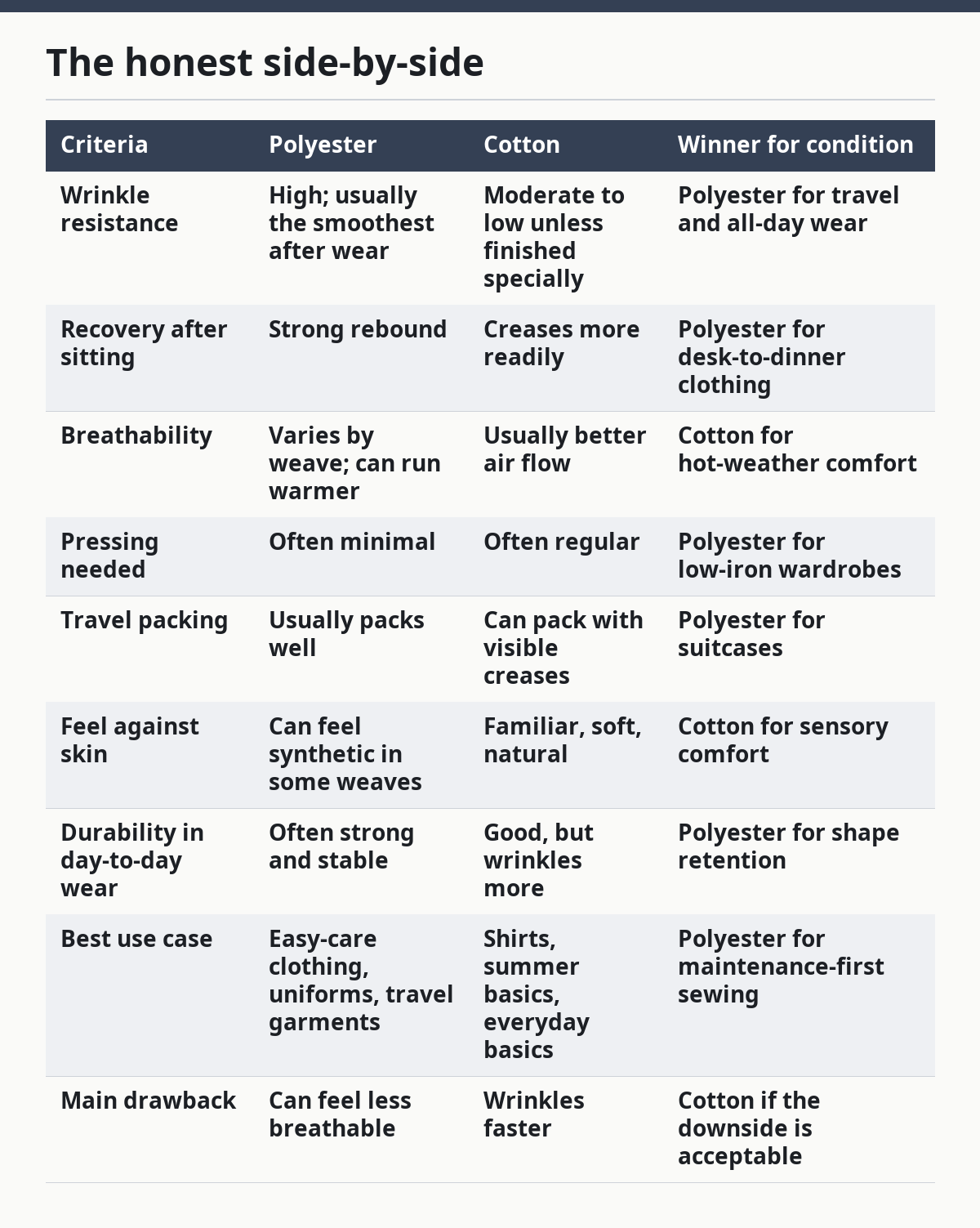
The table makes one thing plain: if the whole decision turns on wrinkling, polyester is the winner. Cotton only becomes the better choice when breathability, hand feel, or natural fiber preference outweigh the maintenance cost. That is the trade-off most readers actually need named.
Which fabric is best if the garment has to travel well?
Polyester is the best travel fabric among the ones listed here, and a polyester-spandex blend is the best compromise if movement matters too. Travel clothes need to leave a suitcase looking presentable after a long ride, not after a laundry-room press. That is where polyester pulls ahead of cotton, viscose, and linen.
A travel-friendly fabric needs three things: crease resistance, recovery, and enough body to hang cleanly. Polyester handles folding and unfolding better than cotton or linen, while spandex helps garments snap back after sitting. That is why many travel pants, jersey dresses, and wrinkle-resistant shirts rely on synthetic fibers or synthetic-heavy blends. Even a relatively lightweight polyester can outperform a heavier natural fiber once both have spent a night packed in a bag.
The weakness is comfort. Polyester can trap heat more than cotton or linen, especially in a tightly woven cloth or in warm climates. That is the cost of wrinkle control. A traveler who wants both comfort and neatness may prefer a blended fabric rather than pure polyester, especially for long-haul trips or humid weather. A little spandex can improve the wear experience without giving up much wrinkle resistance.
For sewing, the practical recommendation is clear: if the garment’s job is to look acceptable after packing, choose polyester first. If the garment’s job is to feel cool and natural, accept more wrinkles or bring a steamer. That trade-off matters more than fiber labels alone.
The verdict: what to choose, and when to walk away
Choose polyester if you want the least wrinkling and the easiest care in everyday clothes, office wear, and travel garments. Choose cotton if you care more about breathability and comfort than about a smooth surface. Neither if you need a crisp, polished look all day and cannot tolerate even moderate maintenance, because linen and viscose will fight you there.
That is the direct answer for this topic. Polyester is the wrinkle-resistant fabric to start with, and polyester blends with a little spandex are the smartest second choice when comfort and recovery matter too. Cotton is a better feel-first option, but it is not the least wrinkly. Linen and viscose are best treated as style fabrics, not low-maintenance fabrics.
When the answer changes
The overall verdict flips in a few specific situations. A fabric that wrinkles less is not always the best fabric for the job.
- Hot weather, not travel, is the main concern. Cotton or linen may be worth the wrinkling because they often feel cooler against the skin, especially in looser garments.
- The garment is meant to look relaxed and textured. Linen and some viscose pieces can look intentional when creased, so wrinkle resistance stops being the main goal.
- The fabric needs stretch more than smoothness. A polyester-spandex or cotton-spandex blend can be the right balance for fitted clothes, even if pure polyester would wrinkle less.
- Skin comfort matters more than maintenance. If synthetic feel is a dealbreaker, cotton may be the better compromise despite the iron.
That is the part many generic guides miss: the least wrinkly fabric is not always the one a sewer should buy. It is the one that best matches the garment’s use.
Is polyester less wrinkly than cotton?
Yes, polyester is generally less wrinkly than cotton. Polyester fibers resist creasing and recover better after sitting, folding, or packing, while cotton tends to hold wrinkles more easily. That difference shows up most clearly in shirts, travel clothes, and garments that need to look smooth with little pressing. If wrinkle control is the top priority, polyester is the safer choice.
What fabric is easiest to care for?
Polyester is usually the easiest to care for when wrinkle resistance is part of the definition. It typically needs less pressing than cotton, linen, or viscose and often comes out of the wash looking closer to ready-to-wear. The trade-off is feel: some polyester fabrics can be warmer or less breathable than natural fibers.
Do blends wrinkle less than pure fibers?
Yes, many blends wrinkle less than the pure fiber alone, especially when polyester or spandex is part of the mix. A polyester-cotton or polyester-spandex blend often holds its shape better than 100% cotton, and the spandex can improve recovery after wear. The exact result depends on the fiber ratio and the weave, so a blend is not automatically wrinkle-proof.
Drafted with AI; not yet reviewed by a person.