Last updated: November 18, 2026
Quick Answer: For Best Fabrics for Beginners Who Are Learning to Sew, a stable woven fabric is usually the easiest place to start, and quilting cotton is the most common first choice. It stays put under the needle, presses cleanly, and frays less than many tricky fabrics. If the goal is to learn straight seams, corners, and simple pressing without fighting the cloth, start there before you touch silky, stretchy, or very loose weaves.
Key takeaways
- Quilting cotton is often the safest first choice for learning seam control and basic pressing.
- Cotton lawn, chambray, and other stable wovens can also be beginner-friendly if they are not too loose or slippery.
- Linen teaches good sewing habits but wrinkles and frays more, so it is a step up, not the easiest starting point.
- Fleece is easy to cut and forgiving at the needle, but it can hide sloppy stitching and bulk up quickly.
- Denim is excellent for learning heavy-duty sewing, but only after the basics feel steady.
- Stretch knits and slippery fabrics usually punish new mistakes faster than stable woven fabrics do.
The best beginner-friendly fabric in one sentence
Quilting cotton is often the best beginner-friendly fabric because it is stable, affordable enough to experiment with, and easy to read under the presser foot. That combination matters more than trend, drape, or texture when someone is still learning how fabric behaves.
A generic “beginner fabric” list often mixes together easy cloth and easy projects. Those are not the same thing. A fabric can be simple to sew but awkward to press, or easy to cut but hard to keep aligned. Quilting cotton gives the cleanest training wheels because its weave holds shape, its edges behave predictably, and it accepts a hot iron without the same drama you get from synthetics or stretch fabrics.
This is the fabric I would hand to someone who wants to practice:
- a straight seam at 2.5 mm stitch length
- pivoting at corners
- turning a pressed hem of 1/4 inch or 1/2 inch
- learning what “grainline” looks like in real cloth
It is not perfect. Quilting cotton can feel stiff in the first wash, and some prints are printed on a looser base that behaves worse than the fabric looks. Very thin cotton can fray faster than a beginner expects. If the question is “what fabric gives me the best chance of a clean first project?”, quilting cotton is a strong answer.
If the reader wants the bigger picture of fabric choice beyond beginner picks, the hub on how to choose fabric for sewing belongs there; this page is only about what is easiest to learn on first.
Which fabrics are easiest to learn on?
Stable woven fabrics are usually the easiest to learn on because they stay close to where you put them. That makes seam allowances, corners, and hems far less frustrating than with slippery satin, jersey, or anything with strong stretch.
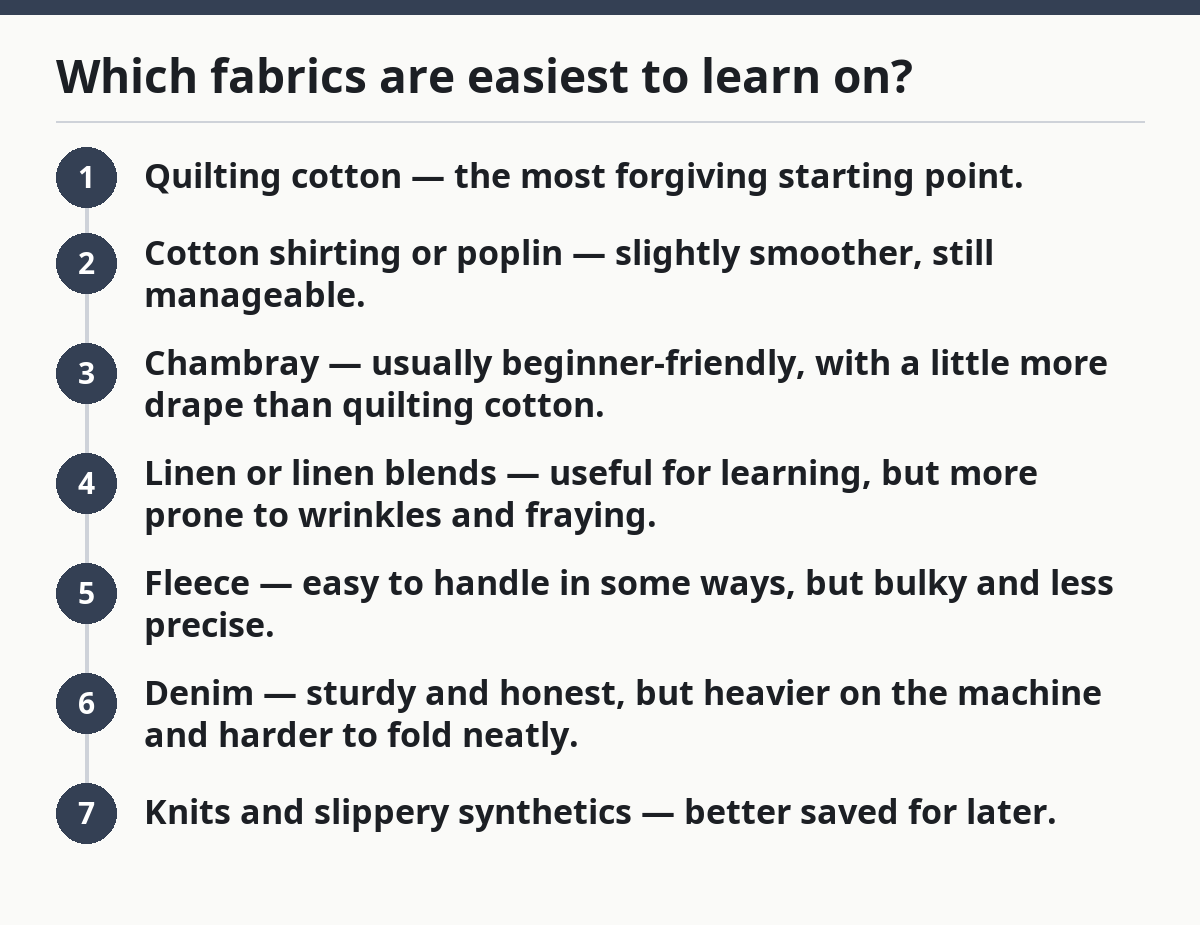
Here is the practical order I would put them in for a beginner:
- Quilting cotton — the most forgiving starting point.
- Cotton shirting or poplin — slightly smoother, still manageable.
- Chambray — usually beginner-friendly, with a little more drape than quilting cotton.
- Linen or linen blends — useful for learning, but more prone to wrinkles and fraying.
- Fleece — easy to handle in some ways, but bulky and less precise.
- Denim — sturdy and honest, but heavier on the machine and harder to fold neatly.
- Knits and slippery synthetics — better saved for later.
The trick is not to choose the “softest” fabric. A brushed rayon can feel lovely in the hand and still slide around like soap on tile. A crisp cotton poplin may feel plain, but it behaves beautifully when you are trying to learn a 1/4-inch seam.
Look for these beginner-friendly qualities:
- A plain, visible weave so you can see threads and grain.
- Moderate weight rather than very thin or very heavy cloth.
- Low stretch across the width and length.
- Edges that fray slowly enough for you to finish a seam before chaos starts.
The point is to make the fabric reveal your sewing, not hide it. Beginner sewing improves fastest on cloth that shows mistakes without punishing every one of them.
How do cotton, linen, fleece, and denim compare?
Cotton is usually the easiest all-around choice, linen is the best teacher with trade-offs, fleece is forgiving but bulky, and denim is strong but demanding. Those four names come up often because they teach very different lessons.
Cotton
Cotton, especially quilting cotton, is the default recommendation for a reason. It usually presses crisply, holds shape during cutting, and comes in enough weights to find a comfortable starting point. It does fray, but not so fast that every edge becomes a race. If you are making pillow covers, simple tote bags, or practice seams, cotton is the cleanest first step.
Who should not start with cotton? A learner who only wants soft drapey garments may find cotton too crisp to teach the behavior they care about later. Still, it is the most reliable training fabric.
Linen
Linen is a very good learning fabric once the basics feel less awkward. It is stable, breathable, and honest about the quality of your seam work. It also wrinkles easily and frays more than quilting cotton. That means a beginner will spend more time managing raw edges and pressing than they would with cotton.
Who should not start with linen? Someone who gets discouraged by visible wrinkles or wants a very neat first finish. Linen can make a new sewist feel clumsy even when the stitching is fine.
Fleece
Fleece is easy to cut and does not fray in the same way woven fabrics do, which sounds ideal until the seams start getting bulky. It can also shift and stretch under the presser foot if the feed dogs pull unevenly. Fleece is friendly for simple blankets and casual projects, but it does not teach precision as clearly as woven cotton.
Who should not start with fleece? Anyone trying to learn accurate pressing, sharp corners, or crisp seam lines. Fleece hides too much.
Denim
Denim is durable and stable, but it asks more from the machine, the needle, and the sewist. It usually needs a stronger needle and a slower hand, and thick layers at seams can feel like a fight. Denim is useful for learning how to manage heavier fabric, but not as the first cloth for a nervous beginner.
Who should not start with denim? Someone using a basic machine that struggles with thickness, or anyone still getting comfortable with threading, tension, and straight stitching.
A simple fabric ranking by difficulty and learning value
Quilting cotton teaches the most with the least friction, while stretchy or slippery fabrics teach the most frustration. That ranking matters because a beginner is not just buying fabric; they are buying the chance to practice one skill at a time.
Here is the ranking I would use for someone learning basic sewing:
1. Quilting cotton
This is the best balance of stability, easy marking, and predictable pressing. It also makes seam allowance errors obvious without turning every mistake into a disaster.
2. Other stable cottons
Cotton poplin, cotton shirting, and cotton lawn can be good after quilting cotton. Poplin is crisp and neat. Cotton lawn is finer and often pleasant for clothing practice, but it can be a little more delicate than quilting cotton.
3. Chambray
Chambray behaves well and looks more like everyday clothing fabric than quilting cotton. It is a smart bridge between practice cloth and real garments.
4. Linen and linen blends
These reward careful pressing and clean seam finishing. They are excellent for learning how fabric responds to heat, but they fray enough to demand attention.
5. Fleece
This is easy in one sense because it does not fray, but it is less useful for learning exact seam work. It also can make beginner hems and topstitching look messier than they are.
6. Denim
Good for learning strength and control, not ideal for a first project. Thick seam intersections can overwhelm a beginner machine and a beginner hand at the same time.
7. Stretch knits and slippery fabrics
Jersey, satin, rayon challis, and similar fabrics are poor first picks. They move, roll, or stretch before the sewer has the muscle memory to control them.
A useful rule: if the fabric slides, stretches, or sheds threads in a hurry, it is probably too early. Save it for after 3 or 4 confident practice projects.
What makes a fabric easy or hard to sew?
A fabric is easy to sew when it stays where you place it, responds to heat without drama, and does not unravel faster than you can stitch. Those three traits matter more than whether the cloth looks expensive or feels soft in the store.
Use this quick decision process before buying a first fabric:
- Hold the fabric open under light. If you can clearly see a regular weave, the cloth is usually easier to manage than something with a loose or floaty structure. A 100% cotton woven often passes this test cleanly.
- Pull it gently across the grain. A little give is normal, but if it stretches like jersey, it will be harder to keep seams even. Stable wovens are better for a first 1/2-inch seam than knits.
- Rub the cut edge. If threads fall away immediately, expect more fraying and more finish work. That does not make the fabric impossible, but it slows a beginner down.
- Press a small corner with medium-to-hot heat. Cotton and linen usually take a press well. Fabrics that shine, pucker, or melt tell you to back off before you build a project around them.
- Check thickness at folds. If three layers already feel bulky in your hand, the hem, zipper, or corner will be harder at the machine. Thin does not always mean easier, but very bulky cloth raises the difficulty fast.
There is one trade-off worth saying plainly: the easiest fabric to sew is not always the prettiest fabric to wear. A beginner often wants a “real” garment fabric right away, but a stable cotton is still the smarter first teacher. It lets the sewer practice the machine, not battle the material.
For authority on fiber behavior and textile care, the Cotton Incorporated Learning Center and University of Nebraska–Lincoln Extension sewing guides are good places to cross-check basic fabric terms without guessing. Cotton is a natural fiber, and university extension guides regularly recommend starting with stable woven cloth before moving to stretch or drapey materials.
Fabrics beginners should avoid for the first few projects
Slippery, stretchy, and very loosely woven fabrics should usually wait until the basics feel automatic. They are not bad fabrics; they are just bad teachers for a first or second project.
Avoid these at first:
- Jersey and most knits: they stretch out of shape, curl at the edges, and can wobble under a standard presser foot.
- Satin and silk-like synthetics: they slide, snag, and show every pin mark.
- Rayon challis and similar drapey fabrics: they feel beautiful but drift while cutting and sewing.
- Very loose linens or gauzy cottons: they fray quickly and can distort before the seam is finished.
- Very thick coatings or multiple heavy layers of denim: they can be too much for a first machine setup.
The cost of starting with these fabrics is not just a crooked seam. They can make a beginner blame the machine, the pattern, or their own hands when the real problem is simply the wrong material for the lesson.
If the goal is a first tote bag, pillow cover, apron, or simple skirt, a stable woven beats almost every fashionable fabric choice. A beginner can always move into difficult cloth later, after the machine habits are solid.
A fabric that is easy to sew should also make pressing easier. Quilting cotton and other stable wovens usually press into place cleanly; rayon and synthetics often need more caution because heat can flatten, shine, or distort them. That is another reason the first projects should stay plain and practical.
How to choose your first yardage without guessing
Choose a medium-weight stable woven, preferably quilting cotton, and buy enough for one practice project plus seam mistakes. That usually means one extra piece beyond the minimum called for by the pattern so there is room to recut a hem, redo a seam, or practice a corner again.
A beginner can narrow the choice quickly:
- Pick 100% cotton if the goal is maximum control.
- Pick a plain weave rather than a slippery finish.
- Avoid anything described as stretchy, slippery, drapey, or sheer for the first project.
- Choose a print or solid that makes grain and seam lines easy to see.
- Keep the first project simple enough that the fabric, not the design, is what you are learning.
I would not tell a beginner to chase the “best” fabric in an abstract sense. The better question is: which cloth gives the least friction while teaching the most useful habits? For that job, quilting cotton wins. Linen comes next if the learner wants a little more challenge. Fleece and denim can come later, once seams stop feeling mysterious.
The first yardage should make the machine feel cooperative. If the fabric tugs, slides, frays wildly, or melts under heat, it belongs in a later chapter.
Is cotton the easiest fabric to sew?
Yes, cotton is usually the easiest fabric to sew for beginners. Quilting cotton in particular is stable, easy to mark, and forgiving at the machine, which is why it is often the first recommendation for practice projects. It is not perfect for every garment, but it is the clearest starting point for learning basic seams and pressing.
What fabrics should beginners avoid?
Beginners should usually avoid slippery, stretchy, or very loose fabrics. Jersey, satin, rayon challis, silk-like synthetics, and some gauzy weaves tend to shift, fray, or stretch before a new sewer can control them well. Heavy denim can also be frustrating at first because bulk makes seams harder to manage.
Drafted with AI; not yet reviewed by a person.