Last updated: November 18, 2026
Quick answer: choose a straight stitch for most woven seams, and use a zigzag stitch or another stretch seam option for knits and other fabrics that need give. In How to Choose a Sewing Machine Stitch for Seams, the stitch should match fabric stretch, seam stress, and whether the seam must stay firm or move. A seam on woven cotton is usually best with a straight stitch; a seam on knit fabric usually needs a stitch that can move with the cloth.
Key takeaways
- A straight stitch is the default seam stitch for woven fabric and many crisp garment seams.
- Zigzag stitch gives the seam more movement, which matters on stretch fabric and some edges.
- Seam strength is not just about tightness; it also depends on how the fabric behaves when pulled.
- A stitch that looks neat can still fail if it does not match the cloth.
- The right choice is usually the one that lets the seam hold together without fighting the fabric.
Which stitch should I use for seams?
Use a straight stitch for stable fabric and a zigzag stitch for fabric that stretches or needs more give. That is the simplest rule, and it solves most seam choices on a sewing machine.
A straight stitch makes a clean seam line on woven cloth like cotton, linen, poplin, and denim. It is the standard choice when the seam should stay fixed in one place. A zigzag stitch spreads thread side to side, so it can tolerate movement better than a plain straight line.
If the seam will be pulled, bent, or worn often, stitch choice matters as much as seam allowance. A side seam in a T-shirt and a seam in a tote bag do not ask for the same thing. One needs flexibility; the other needs shape and firmness.
For a machine-made seam on knit fabric, many sewing guides from machine makers recommend a stretch-friendly stitch rather than a plain straight line; see Brother’s stitch guidance and Singer’s sewing tips. For related basics, see seam allowance basics and how stitch length affects seams.
How do straight stitch and zigzag stitch compare?
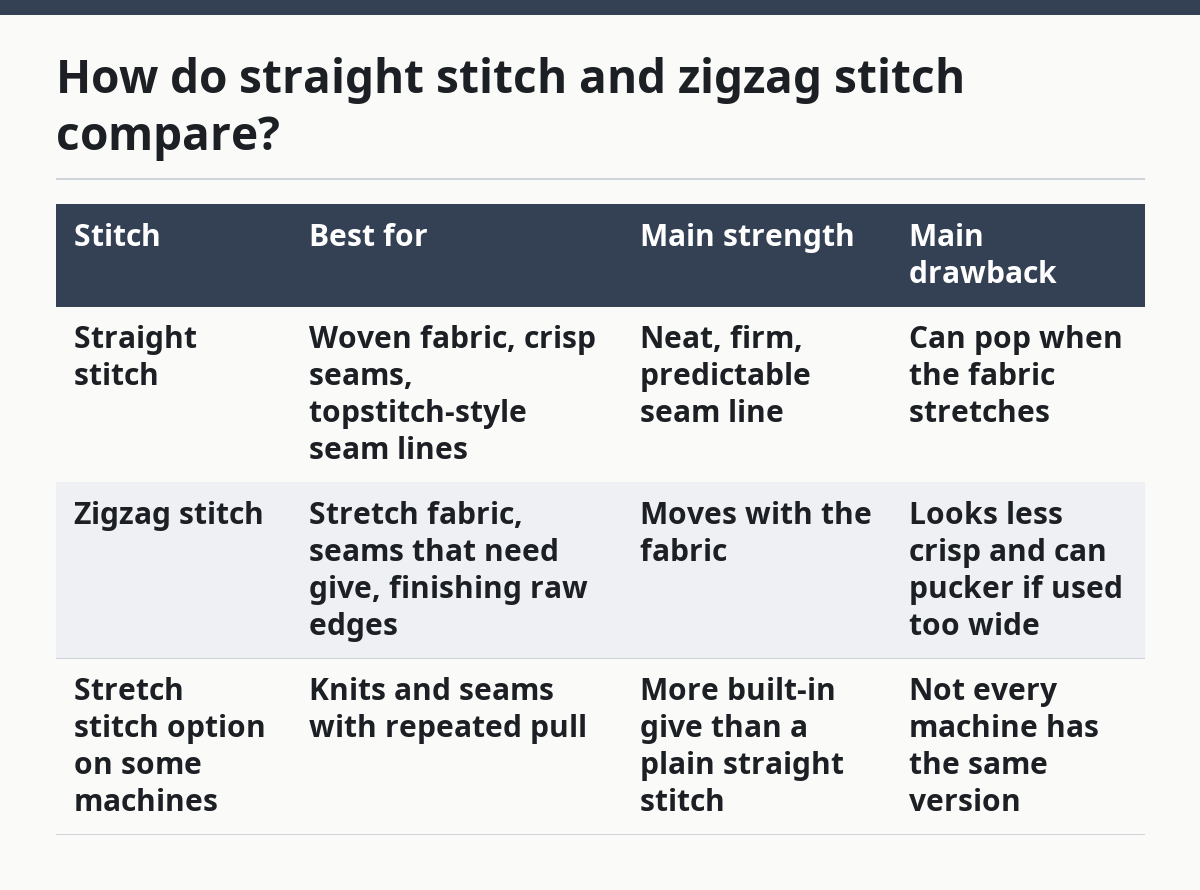
Straight stitch is stronger in a fixed line, while zigzag stitch is better when the seam must stretch. That is why these two stitches show up in almost every beginner guide.
| Stitch | Best for | Main strength | Main drawback |
|---|---|---|---|
| Straight stitch | Woven fabric, crisp seams, topstitch-style seam lines | Neat, firm, predictable seam line | Can pop when the fabric stretches |
| Zigzag stitch | Stretch fabric, seams that need give, finishing raw edges | Moves with the fabric | Looks less crisp and can pucker if used too wide |
| Stretch stitch option on some machines | Knits and seams with repeated pull | More built-in give than a plain straight stitch | Not every machine has the same version |
The practical test is simple: if the fabric itself stretches, a plain straight stitch may fight it. If the fabric stays stable, a zigzag stitch can be more than you need and can make the seam look loose or wavy.
A generic sewing article often stops here, but seam strength and seam behavior are not the same thing. A strong-looking stitch can still be a poor seam if the fabric needs movement. A flexible stitch can still be the wrong seam if the fabric is firm and you want a clean, narrow line.
How do I choose a stitch for my fabric?
Choose the stitch by checking three things in order: the fabric type, how much the seam will move, and how visible the stitch line will be. That gives you a practical answer before you sit at the sewing machine.
-
Name the fabric on the sewing machine before you sew.
If the cloth is woven and stable, start with a straight stitch. If the cloth stretches when you pull it across the grain, start with a zigzag stitch or a stretch seam option. -
Feel the seam line with your hands before the first seam.
Press the edge gently for 2 to 3 seconds. If the fabric opens and springs back, it needs a stitch with more give than a plain straight line. -
Match the stitch to the construction need.
Use straight stitch for side seams, shoulder seams, and other standard joins on woven fabric. Use zigzag stitch when the seam must move, such as on stretch fabric or on a seam that will be tugged often. -
Check the look you want from the seam.
A straight stitch gives a clean, narrow line. Zigzag stitch is more visible and less formal in appearance, so it is best when function matters more than a sharp seam line. -
Choose the least complex stitch that still protects the seam.
If a straight stitch is enough, do not add extra give just because the machine has more options. If the fabric stretches, do not insist on a straight stitch just because it looks tidy.
Because of that order, the decision stays practical. Many sewists start with appearance, then wonder why the seam fails later. The better path is to start with fabric behavior, then decide how the seam should look.
What does seam strength really mean?
Seam strength means the seam can hold under pull, bending, and wear, not just that the thread looks neat. A seam can be stitched cleanly and still open if the fabric stretches more than the stitch can handle.
A straight stitch concentrates its hold along one line. That works well on stable fabric, where the cloth does not try to elongate. On a stretch fabric, though, the same straight line can act like a rigid bar.
A zigzag stitch spreads the thread path, so the seam can move with the cloth. That extra movement is why it often belongs on knit fabric. The trade-off is that the seam line is less precise and can look wider or more obvious.
If the seam is part of a bag handle, a waistband, or another spot that gets repeated strain, stitch choice should lean toward the seam’s job, not only the fabric’s name. A firm woven fabric can still need a stronger construction choice than a decorative one. A light fabric can still need flexibility if it stretches.
When should I use zigzag stitch?
Use zigzag stitch when the fabric stretches, when the seam needs flex, or when you want a little forgiveness in the seam line. That is the stitch’s main job on a sewing machine.
Zigzag stitch is the better choice for stretch fabric because it can move with the cloth instead of locking it into a rigid line. It is also useful when a seam may be pulled open and closed often. The seam can tolerate motion that would stress a straight stitch.
The trade-off is clear. On a crisp woven seam, zigzag can look bulky, looser, or less precise than a straight stitch. On very fine fabric, a wide zigzag can also make the seam edge look uneven. That is why zigzag is not the answer for every seam; it is the answer for seams that need movement.
A good rule is to think of zigzag as a function-first stitch. It is chosen because the seam needs to survive motion, not because it looks polished. That makes it the wrong choice for many structured seams and the right choice for many knits. For more stitch basics, see stitch types on sewing machines.
What are the most common mistakes?
The biggest mistake is using one stitch for every seam on every fabric. That choice costs you either seam strength or seam flexibility, and sometimes both.
Another mistake is picking zigzag stitch just because the machine has it. Zigzag on woven fabric can make the seam look sloppy where a straight stitch would stay crisp. It can also add bulk at the seam line without giving any real benefit.
A third mistake is treating a straight stitch as automatically strong enough for every seam. On stretch fabric, a straight stitch may be neat but not suited to the way the cloth moves. The seam may hold at first and then fail when the fabric is worn or pulled. If you are unsure about a high-stress seam, consult a qualified sewing instructor or garment professional, and check your machine manual.
Which stitch should I avoid for this seam?
Avoid a straight stitch on fabric that must stretch, and avoid a wide zigzag on seams that need a clean, narrow line. That is the simplest way to keep from picking the wrong seam stitch.
If the fabric is a stretch fabric, a plain straight stitch can be too stiff for the seam. If the seam is on a woven fabric and the stitch line needs to stay neat and firm, zigzag may give more movement than the seam needs. A choice that seems fine during sewing can create a problem later.
This is also where a machine’s stitch options can distract more than help. A sewing machine may offer many patterns, but the seam usually needs only a small set of sensible choices. Straight stitch, zigzag stitch, and a stretch seam option cover most seam decisions.
The point is not to use the fanciest stitch. It is to use the stitch that fits the seam’s job. If the seam is meant to hold shape, stay with a straight stitch. If it needs to move, choose a stitch with give.
How does this fit into the rest of machine setup?
Stitch choice is one part of machine sewing setup and stitch control, not a separate trick. The stitch has to match the fabric, the seam, and the result you want from the sewing machine.
If the machine is set for the wrong stitch type, the seam decision can never be fully right. A person can know the fabric well and still get a poor seam if the stitch does not match. That is why stitch choice belongs near the start of every sewing decision, before the seam is sewn.
This topic sits inside a larger set of machine skills: understanding stitch types, controlling stitch length, and matching the seam to the material. Those pieces work together. A good stitch choice gives the seam a fair chance to hold, and it keeps the machine from fighting the cloth.
Which stitch is best for sewing seams?
The best stitch for sewing seams is usually a straight stitch for woven fabric and a zigzag stitch for stretch fabric. That split covers the most common sewing machine seam decisions without making the choice more complicated than it needs to be.
A straight stitch is the default when you want a firm, neat seam line. A zigzag stitch is the better answer when the seam must move with the fabric. A seam on a knit shirt and a seam on a cotton tote do not ask for the same thing.
The wrong stitch can make a seam look fine at first and fail later under wear. That is why the fabric matters more than the machine’s stitch menu. Start with the cloth, then choose the stitch that fits its behavior.
When should I use zigzag stitch?
Use zigzag stitch when the fabric stretches or when the seam needs more give than a straight stitch can provide. That makes it especially useful on stretch fabric and on seams that will be pulled often.
Zigzag stitch is less suited to crisp woven seams where a clean line matters. It can also make the seam look wider than a straight stitch. The trade-off is worth it only when flexibility matters more than a sharp seam line.
Is straight stitch strong enough for seams?
Straight stitch is strong enough for many seams, especially on woven fabric that does not stretch much. It is the standard seam stitch for a reason.
It is not the right choice for every seam, though. On stretch fabric, a straight stitch can be too rigid, and the seam may fail when the fabric moves. That is why strength alone is not the whole answer; the stitch has to fit the fabric’s motion too.
Drafted with AI; not yet reviewed by a person.