Last updated: November 20, 2026
Choose a sewing machine with a strong zigzag, an overcast stitch, and adjustable stitch width if you want clean seam edges without buying a serger. A serger still finishes knits faster and trims as it stitches, but a regular sewing machine can do a solid substitute job for light wear, small runs, and home projects if the stitch options are right.
Key takeaways
- The best serger alternative is not a fancy label; it is a machine with the right stitches and enough control.
- A zigzag finish is the safest fallback, but an overcast or mock overlock stitch looks neater on many fabrics.
- Stretch fabrics need stretch seam finishing, not just a standard straight stitch with cut edges.
- Skip a basic machine with only straight and zigzag if you plan to finish seams often.
- If your sewing is mostly hems, repairs, and one-off garments, a serger alternative can make more sense than a separate serger.
What should a serger alternative sewing machine do?
A serger alternative sewing machine should give you at least one edge-finish stitch, plus enough control to keep seams from curling or tunneling. That means a zigzag stitch, an overcast stitch, or a mock overlock stitch, along with adjustable stitch width and length. A machine with only a basic straight stitch will not solve raw-edge finishing on its own.
The key difference is simple: a serger trims, wraps, and sews in one pass, while a sewing machine usually finishes the edge in two steps. One pass can be enough for many home projects, but it is slower and less tidy on thick, fraying, or very stretchy fabric. If the fabric is woven cotton, a 4 mm zigzag finish may be enough for inside seams. If the fabric is a knit, you need a stitch that stretches with the cloth.
A good replacement choice is a machine that can handle 3 things well: stitch width, stitch length, and fabric feed. Without those, the finish may look homemade in a bad way, even if the seam holds. If the machine has a decorative overcast stitch, that can be useful for visible edge finishing on bags, skirts, and linings.
Skip the “many stitches” sales pitch if the machine does not include clear edge-finishing options. Twenty decorative stitches do not matter if the useful one is missing. For the broader setup around needles, feet, and tension, this page sits under the site’s sewing machine setup hub, which covers the rest of the machine decision without repeating it here.
Which stitch option is the best substitute?
The best substitute depends on the fabric, but a zigzag finish is the most useful all-purpose choice. It is easy to find on almost every sewing machine, and it can bind a raw edge when the stitch width is set wide enough to catch the cut edge without pulling it hard.
Here is the short comparison that helps most shoppers make a choice:
| Option | Best for | Why someone would switch to it | What to skip |
|---|---|---|---|
| Zigzag stitch | Wovens, quick seam finishes, basic edge control | It is common, flexible, and usable on many machines | Skip it for a polished knit finish if a stretch stitch is available |
| Overcast stitch | Raw edges that need a cleaner look | It wraps the edge more neatly than a plain zigzag | Skip it if the stitch is missing from the stitch menu |
| Mock overlock stitch | Home-sewn garments and visible inside seams | It gives a look closer to a serger finish without another machine | Skip it on very thick seams if the machine struggles |
| Stretch seam finishing | Knits and activewear-style fabrics | It moves with the fabric better than a plain finish | Skip a standard straight stitch on stretchy cloth |
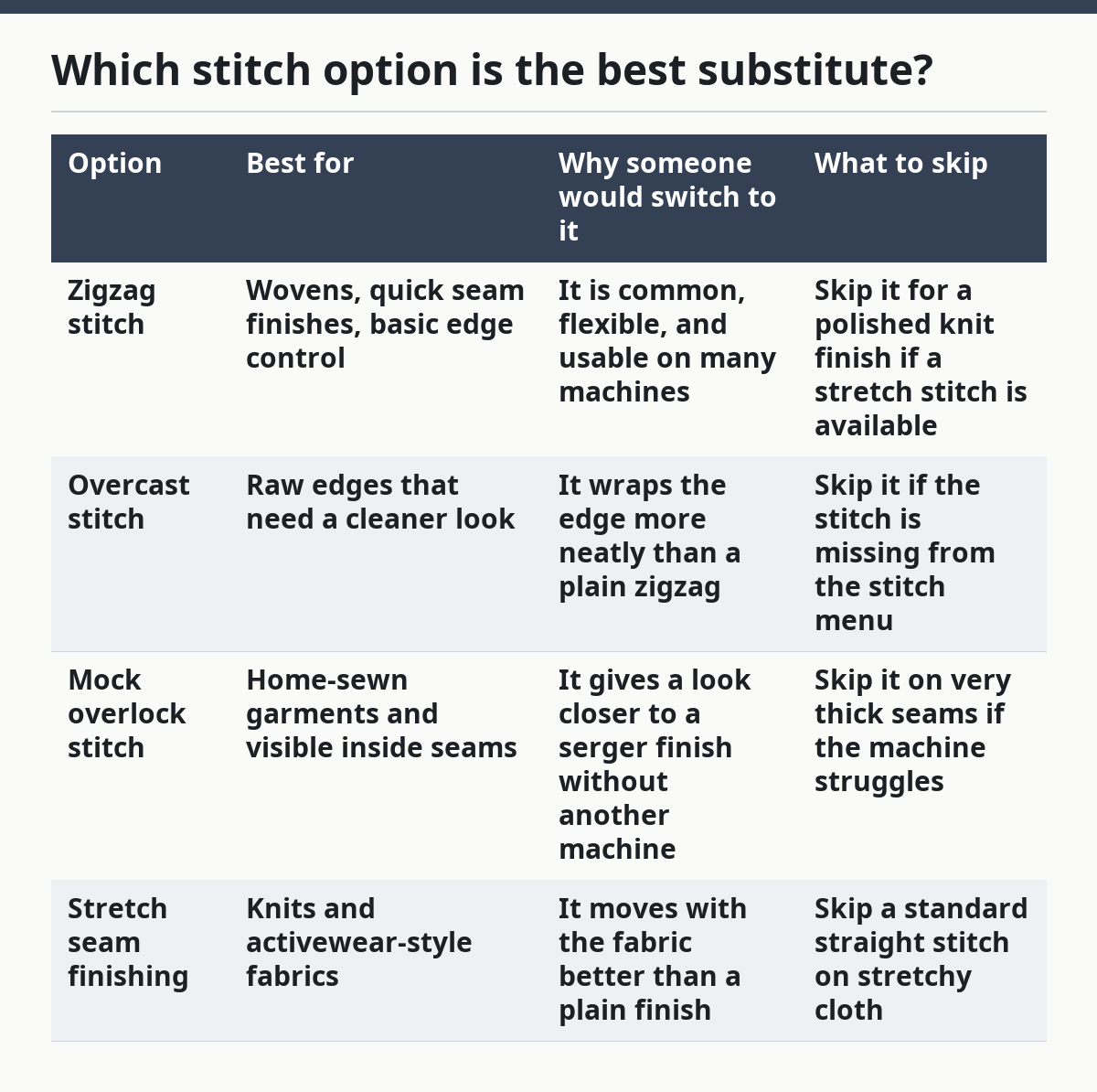
A mock overlock stitch is the most serger-like substitute on a regular sewing machine, but it is not automatic. Some machines call it an overedge stitch or overcast variation. That is why the stitch chart matters more than the sales name. If the chart shows a stitch that catches the edge with a side-to-side motion, that is the feature to look for.
A zigzag finish is still the safe fallback when the machine offers little else. It is not as neat as a serger seam, and it can feel bulky on heavy fabric, but it works. A wide zigzag also gives more room for error than a narrow one. For most shoppers, that is better than buying a machine packed with stitches that never get used.
How do you choose the right sewing machine?
Choose the machine by fabric type first, then by stitch menu, then by how often you finish seams. That order matters more than brand loyalty or decorative extras.
- Check the stitch list for 1 or 2 edge-finish options. Look for zigzag, overcast, mock overlock, or a stretch stitch. If the list only shows straight stitch and buttonhole, move on.
- Look for adjustable width and length. A zigzag that can open wider than 3 mm gives more edge coverage, while a length around 2.5 mm to 3 mm usually stays readable on the seam edge.
- Match the stitch to the fabric you sew most. Wovens need clean edge binding; knits need a stitch that can flex. A machine that handles both is better than one with fancy but narrow uses.
- Check whether the machine gives access to the stitch chart without guessing. If the manual names the stitch as overcast, overedge, or mock overlock, you know what to try first.
- Skip models that depend on a single decorative stitch to do all the work. A decorative stitch may look similar to an overlock finish, but it may not hold a seam edge under regular wear.
- Keep the budget tied to use. If the main job is hemming and mending, paying for dozens of embroidery patterns makes little sense. If the main job is garment sewing, edge-finishing control matters more than pattern count.
A smart buyer also thinks about what will not be done on this machine. If the goal is to sew a few seams a month, a simple zigzag machine may be enough. If the goal is repeated knitwear or lots of seam finishing, a machine with a genuine overcast or mock overlock stitch is worth the search.
This is where a generic shopping guide often goes wrong: it treats all sewing as the same. A plain woven pillow cover, a T-shirt hem, and a tote bag seam do not ask the same thing from the stitch plate. One machine can cover all three only if it has the right stitch family, not just a long list of decorative names.
What stitch finish should you expect on wovens and knits?
A woven fabric should usually be finished with a zigzag or overcast edge, while a knit needs a stretch-friendly finish that can move without breaking. That is the part many first-time buyers miss when they compare a sewing machine to a serger.
On woven cotton or linen, a zigzag finish can stop fraying at the edge. A narrower overcast stitch can look cleaner, especially on lighter cloth. If the seam is hidden inside a cushion cover or curtain panel, the finish only needs to hold. If the edge will show inside a garment, appearance matters more.
On knit fabric, a plain zigzag may work for some light projects, but not every knit behaves the same way. A stretch seam finish is the better match when the fabric needs to expand. A straight stitch alone can hold a knit seam closed, but it can also pop when the cloth stretches. That is why a machine marketed as a serger alternative should be judged by its stretch-capable stitches, not just by the number of stitch patterns.
The useful rule is simple: if the fabric bends and pulls in daily use, the seam finish must bend too. If the fabric stays mostly still, a standard edge finish is enough. That is why a machine with both zigzag and stretch options is a more practical buy than one with only decorative choices.
What should you skip?
Skip a sewing machine that cannot do more than straight stitch and basic zigzag if your main goal is seam finishing. That kind of machine can sew, but it will not give you the cleaner edge control that makes a serger alternative worth buying.
Also skip machines that advertise a long stitch list but do not show how the edge-finishing stitches are used. A decorative leaf stitch or shell stitch does not replace an overcast stitch. The finish may look busy, not secure. If the stitch guide does not mention edge finishing, it is probably not the feature you need.
A second thing to skip is the idea that the serger alternative must look exactly like a serger seam. It will not. A sewing machine finish is usually flatter, slower, and more visible. That is not failure; it is the trade-off. If the project is a lined jacket, a pillow cover, or a repair, the finish can still be perfectly acceptable. If the project is high-volume knitwear production, the regular machine is the wrong tool.
A third mistake is buying for rare use. A machine with a mock overlock stitch sounds appealing, but if most sewing is straight seams and hems, the extra feature may not pay for its space or cost. For light home use, a dependable zigzag and a clear manual may be enough. For regular garment work, the extra stitch options matter more.
How do you finish edges without a serger?
Finish edges without a serger by choosing one stitch, setting it for the fabric, and sewing the raw edge before the seam gets bulky. That keeps the process simple and stops the finish from becoming messy halfway through.
- Trim the seam allowance to a consistent width. A steady edge helps the stitch bite evenly, and a common allowance like 5/8 inch keeps the finish predictable.
- Choose the stitch that matches the fabric. Use zigzag for basic woven edges, overcast for a cleaner look, or a stretch stitch for knit seams.
- Set stitch width and length for coverage, not crowding. A wider zigzag covers more edge; a moderate length avoids a tight, stiff line.
- Sew the raw edge before pressing the seam open or to one side. This keeps loose threads under control and produces a tidier inside finish.
- Inspect the edge after 10 to 15 stitches. The cloth should lie flat, and the edge should be caught without bunching or puckering.
- Repeat the same setting on the other side of the seam if needed. Double finishing adds time, but it helps on fray-prone fabric.
- Press the seam once the finish is complete. A pressed edge looks cleaner and helps the stitch settle.
This method is slower than a serger, but it gives a usable result on many home projects. It also teaches the difference between holding a seam and finishing an edge. Those are related jobs, but they are not the same job.
Two reliable reference points are the stitch guides from major sewing machine makers and the sewing machine education pages from organizations such as the American Sewing Guild. Their stitch charts and basic finishing notes are useful because they show how manufacturers and sewing educators classify zigzag, overcast, and stretch stitches. A good machine choice should line up with that language, not fight it.
Which choice fits your sewing?
The right choice is a sewing machine with zigzag plus one real edge-finishing stitch if you want a practical serger alternative. That is the sweet spot for most home sewists who want cleaner seams without buying another machine.
Choose the simpler machine if your sewing is mostly repairs, hems, and one-off woven projects. Choose the stronger stitch menu if you sew knits, make garments, or want inside seams that look more finished. Skip the machine with the longest accessory list if it lacks a true overcast or stretch option. A plain straight stitch machine is not enough for this job, and a crowded stitch chart without edge-finishing value is just noise.
The best shopper question is not “How many stitches does it have?” It is “Which one will finish my seams on the fabric I actually use?” When that answer is clear, the machine choice gets much easier.
Drafted with AI; not yet reviewed by a person.