Last updated: November 20, 2026
Quick Answer: use 3 checks in about 1 minute per fabric—daylight, a dark underlayer, and a light underlayer—to see whether a garment needs lining or layering. If you want to know whether a garment needs lining or layering, How to Test Fabric for Transparency Before Sewing gives the answer before you cut a single piece.
Key takeaways
- Transparency changes with light, color, weave, and stretch, so the same fabric can look fine on a table and see-through on a body.
- A daylight check plus a dark-and-light underlayer check gives a clearer read than any single look.
- Thin knits, loose weaves, and light colors often need lining or a second layer.
- The goal is not perfect opacity in every case; it is knowing what will show in the finished garment.
- If a fabric is borderline, plan for lining before cutting, not after.
What does fabric transparency really tell you?

Fabric transparency tells you how much of the body, underwear, or construction details will show through the cloth once it is sewn into a garment. A fabric can look opaque in a stack of yardage and still turn sheer when it is stretched, curved, or hit by strong light.
A good check looks at three things: the light source, the color behind the fabric, and the fabric density. Dense fabrics with tight weaves usually hide more than loose, airy fabrics. Lightweight white, ivory, and pale pastels often need more scrutiny because they reflect light differently than dark fabric.
This matters most before cutting because transparency changes your pattern choice. A skirt, blouse, or dress that looks fine on the bolt may still need lining if the seam allowances, darts, or underwear lines show through. That is why this topic belongs in fabric selection and preparation, before the first cut. For broader planning, see the fabric selection guide and lining basics.
The easiest rule is plain: if you can clearly see the outline of a hand, a dark garment, or underwear through the fabric in normal light, treat it as transparent enough to need a lining, underlayer, or different garment plan, and if you are unsure, consult a professional. That is not a failure of the fabric; it is a design fact. According to the Textile School, opacity and transparency can change with construction and light, and a garment test is still needed.
How to test fabric transparency before sewing
You test fabric transparency before sewing by checking it in daylight, then repeating the check with dark and light backgrounds. The fabric transparency test works best when you use the same piece of fabric for all checks, because a folded layer can hide problems that a single layer will show.
- Place the fabric over a plain white surface in daylight and look for shadows, seams, or your hand outline through one layer.
- Move the fabric to a dark surface and check whether the background color shows through the cloth.
- Hold the fabric in front of a window or other strong light source for 10 to 15 seconds and note where the weave opens up.
- Stretch the fabric gently across your fingers and watch for new gaps, especially in knit fabric.
- Layer the fabric over underwear or another garment and see whether the underlayer remains visible at the front, back, and side.
- Compare the result on the fold, on the bias, and at a seam allowance edge, since those spots often show more than the center.
A daylight check catches the most obvious issues, but the underlayer test tells you what matters in real wear. If skin tone, underwear, or a pocket bag shows clearly, the fabric is not opaque enough for the garment shape you had in mind. If the center looks fine but the fold or seam edges show through, the finished garment may still need lining or a second layer. For a related fit check, see garment fit and fabric prep.
Use the same light source for each pass if you can. A north-facing window, an unshaded window, or a strong lamp can all work, but each gives a different read. The key is consistency, not a magic bulb.
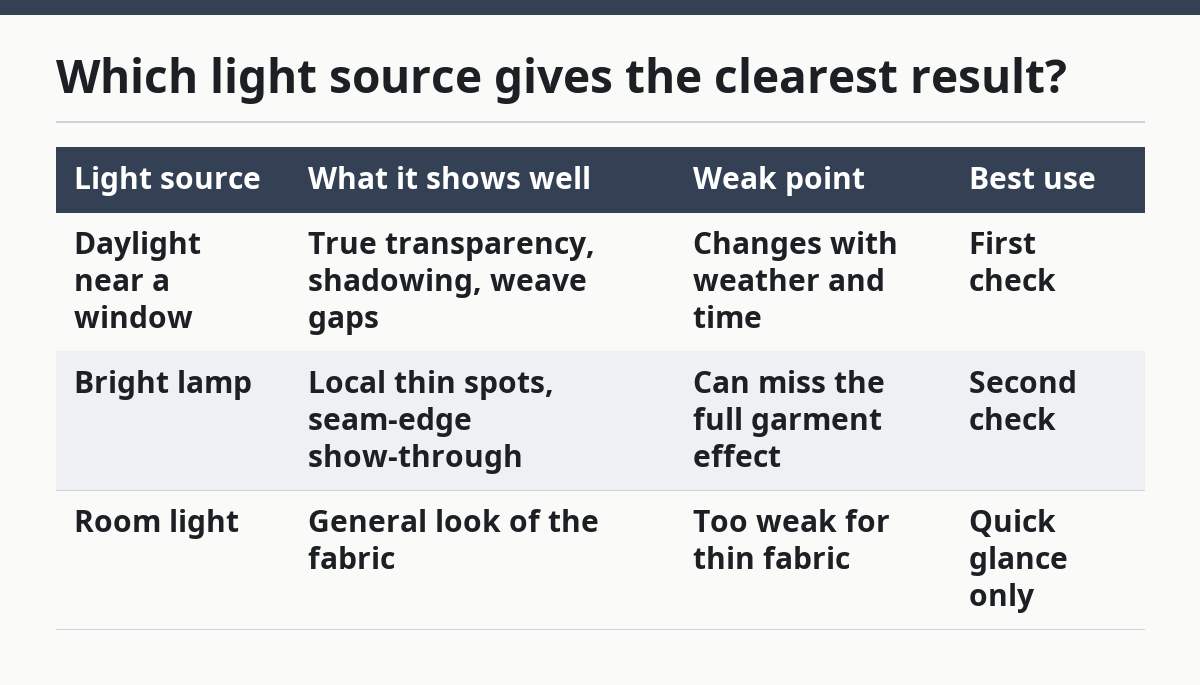
Which light source gives the clearest result?

A window in daylight usually gives the clearest result, and a strong lamp comes next. Natural light shows small gaps in the weave that indoor room light can hide, which is why fabric can pass a table check and fail a window check in under 1 minute.
Use a simple comparison like this:
| Light source | What it shows well | Weak point | Best use |
|---|---|---|---|
| Daylight near a window | True transparency, shadowing, weave gaps | Changes with weather and time | First check |
| Bright lamp | Local thin spots, seam-edge show-through | Can miss the full garment effect | Second check |
| Room light | General look of the fabric | Too weak for thin fabric | Quick glance only |
The window test matters most when you are deciding on lining need. Hold the fabric upright, not flat on a table, because gravity changes the way the cloth hangs. A woven fabric that looks fine flat can open up when vertical, and a knit can become more transparent when pulled.
If you want a quick yes-or-no answer, compare the fabric against a dark underwear color and a light one. A fabric that hides white but not black is borderline, not fully opaque. That kind of result means the garment may need lining in the body area, even if sleeves or panels can stay single-layer. For more on light behavior, the National Institute of Standards and Technology is a useful general reference on measurement conditions.
How do you judge underlayer visibility?
You judge underlayer visibility by checking whether underwear, skin tone, or a dark garment can be seen through one layer of fabric at normal viewing distance. This is the most useful test because it matches real wear, not just a flat swatch on a table.
Use a plain underlayer first. A black, white, and nude undergarment each tells you something different, and the contrast can change the answer fast. If the fabric hides white underwear but shows dark underwear, it is not opaque enough for a garment that will be worn without lining.
Pay attention to the edges of the underlayer. A seam, elastic band, or bra edge showing through is more important than a blurry color shift. That kind of visibility often matters in fitted garments, especially around hips, bust, and seat areas.
Do not stop at the center of the fabric. Check at least three spots: the middle, a cut edge, and an area that has been handled or folded. Fabric density can vary across the bolt, and any thin patch can affect the whole garment. A quick 30-second check on one spot is not enough.
When does fabric need lining or layering?
Fabric needs lining or layering when the transparency test shows underwear, skin, or inner construction details in places the finished garment should cover. The decision is not about the fabric being “good” or “bad”; it is about how much you want the finished garment to reveal.
A light blouse may be fine with a camisole underneath, while a fitted skirt may need a full lining to prevent show-through at the seams. A dress with a sheer bodice may use an opaque lining in the top and leave the sleeves unlined if the design allows it. The answer depends on the garment, not just the fabric.
Here is a quick way to think about it:
- Clear show-through in strong light: plan lining.
- Slight shadowing only: consider underlining or a slip.
- Visible underwear or skin tone: treat it as too transparent for single-layer wear.
- Transparent only when stretched: test again in the fitted areas of the pattern.
The trade-off is weight and warmth. Lining can make a garment heavier and less breathable, while layering can change the drape and fit. That is why a fabric that barely passes a flat test may still not suit a close-fitting blouse or pencil skirt. If the garment depends on a clean outer shape, it is better to know before you cut.
What mistakes make a fabric seem less or more transparent than it is?
The biggest mistake is testing only one layer on a flat table, because that can hide the real level of transparency. A folded piece of fabric is thicker than the final garment, so the test can give a false sense of coverage in less than 1 minute.
Another common mistake is using the wrong background. If you test white fabric on a white table, the fabric may seem more opaque than it is. If you test a dark fabric on a dark background, the opposite can happen. Use both light and dark underlayers so the result is clearer.
A third mistake is ignoring stretch. Knit fabric often looks fine until it is pulled across the body, then the gaps open and the underlayer shows through. This is one reason a fabric can be suitable for a loose top but not for a fitted garment.
Here is the practical cost of each mistake:
- Flat-only test: you may skip lining and get show-through later.
- One-color background: you may misread the fabric’s actual opacity.
- No stretch check: you may cut a fitted piece that becomes too sheer when worn.
- No seam-edge check: you may miss transparency where the garment is most visible.
A careful test takes a few minutes, not a whole afternoon, but it saves the much bigger cost of remaking a garment. If the result is borderline, assume the fabric will behave worse in movement than it does in your hands.
What does a quick at-home comparison look like?
A quick at-home comparison shows you the difference between nearly opaque fabric and truly see-through fabric in one pass. The simplest setup is a window, a plain wall, and two underlayers in different colors.
Use this comparison table:
| Test setup | Good sign | Warning sign |
|---|---|---|
| White underlayer behind fabric | Little or no outline | Bright shape or seam shows through |
| Dark underlayer behind fabric | Hazy color only | Clear dark block or edge visible |
| Hand behind fabric in daylight | Only a soft shadow | Finger shape and skin tone visible |
| Fabric held upright | Even coverage | Gaps appear when hanging |
This is the fastest way to decide whether to keep sewing, line the garment, or switch to another fabric. If the fabric behaves differently in each setup, trust the strongest sign of transparency. The fabric does not have to be fully sheer to need lining; even partial show-through can change how the garment wears.
For deeper fabric selection help, the fabric selection hub covers the bigger decision tree without repeating this transparency check. That keeps this page focused on one job: finding out what the fabric will show before the first cut. A quick screen-physics overview is also available from Britannica.
How do I know if fabric is see-through?
Fabric is see-through if you can clearly make out skin, underwear, or a dark object behind it in normal daylight. A soft blur is less serious than a sharp outline, but the outline is the warning sign that matters for sewing. If the result changes a lot when the fabric is stretched, plan for a lining or a different garment shape.
Do I need lining for sheer fabric?
Sheer fabric usually needs lining, a slip, or another layer if the garment is meant to be worn on its own. The exact choice depends on the pattern and how much coverage you want. If the fabric shows underwear or seam details in daylight, single-layer construction is usually not enough for a finished garment.
What can I use to test fabric in daylight?
You can use a window, a plain wall, a dark shirt, a white sheet of paper, or your hand as a daylight test tool. A bright window with both dark and light backgrounds usually gives the clearest comparison, because that shows contrast fast. A lamp can help too, but daylight is usually the clearer first check.
FAQ
Can I test transparency with just one fabric layer?
Yes. One layer is the right starting point, because it shows the fabric’s real opacity more clearly than a folded sample.
What is the fastest transparency test?
A 30-second window test is the fastest useful check: hold the fabric upright, then compare a dark and light underlayer.
Does stretch always make fabric more transparent?
Often, yes, especially in knit fabric. Stretch opens the gaps, so test the pattern areas that will be fitted.
Is a fabric that shows a shadow still usable?
Yes, sometimes. A soft shadow may work for a loose garment, but visible underwear or skin tone usually means you need lining or another layer.
Drafted with AI; not yet reviewed by a person.